Published on
BEL ÉTAGE. The Art Business Mocks Itself, Then Packs Up
by Florian Jäger
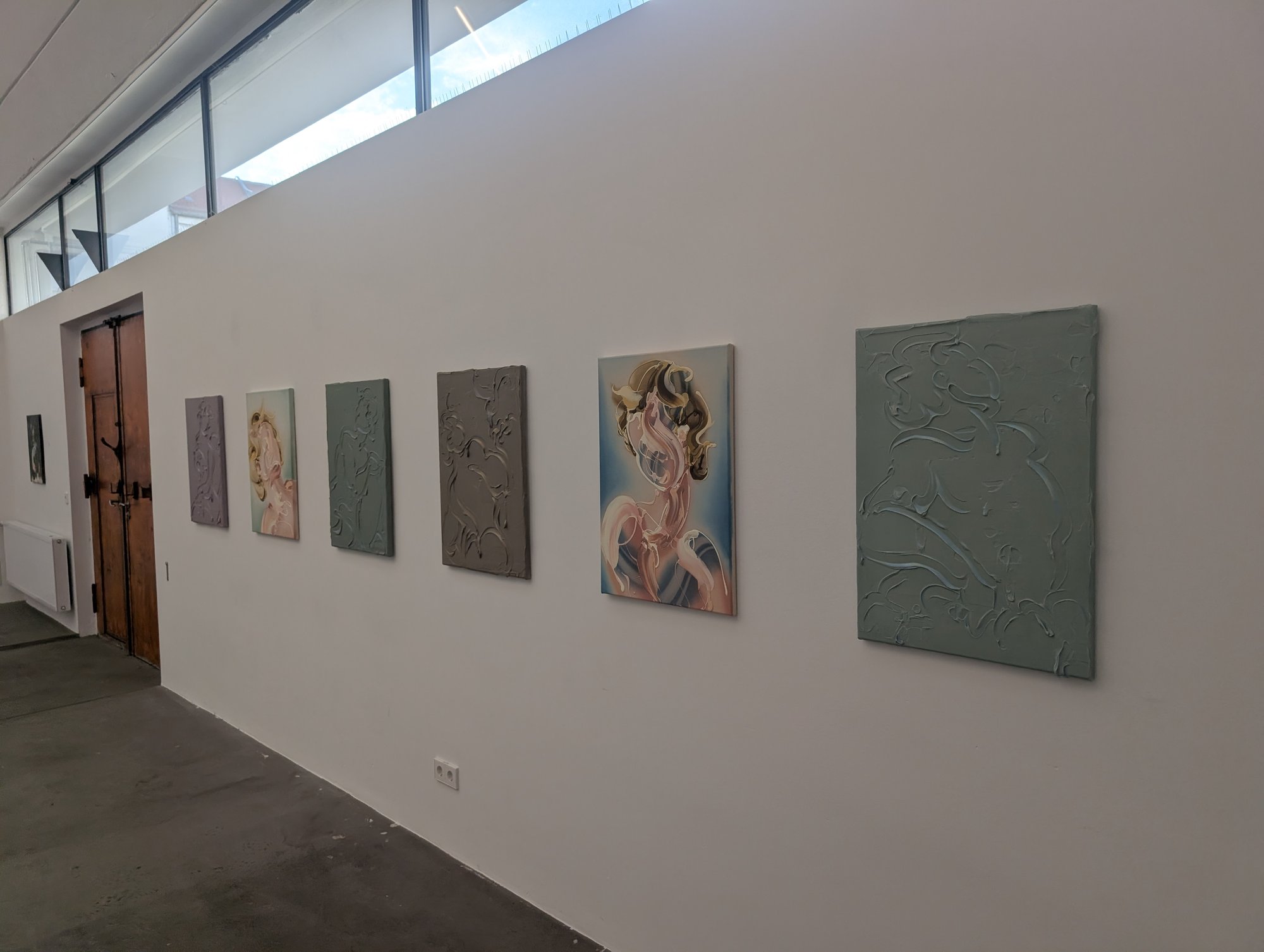
Relief paintings and figurative canvases in the corridor at "BEL ÉTAGE", BACKSPACE. Photo: Florian Jäger, 13 September 2026
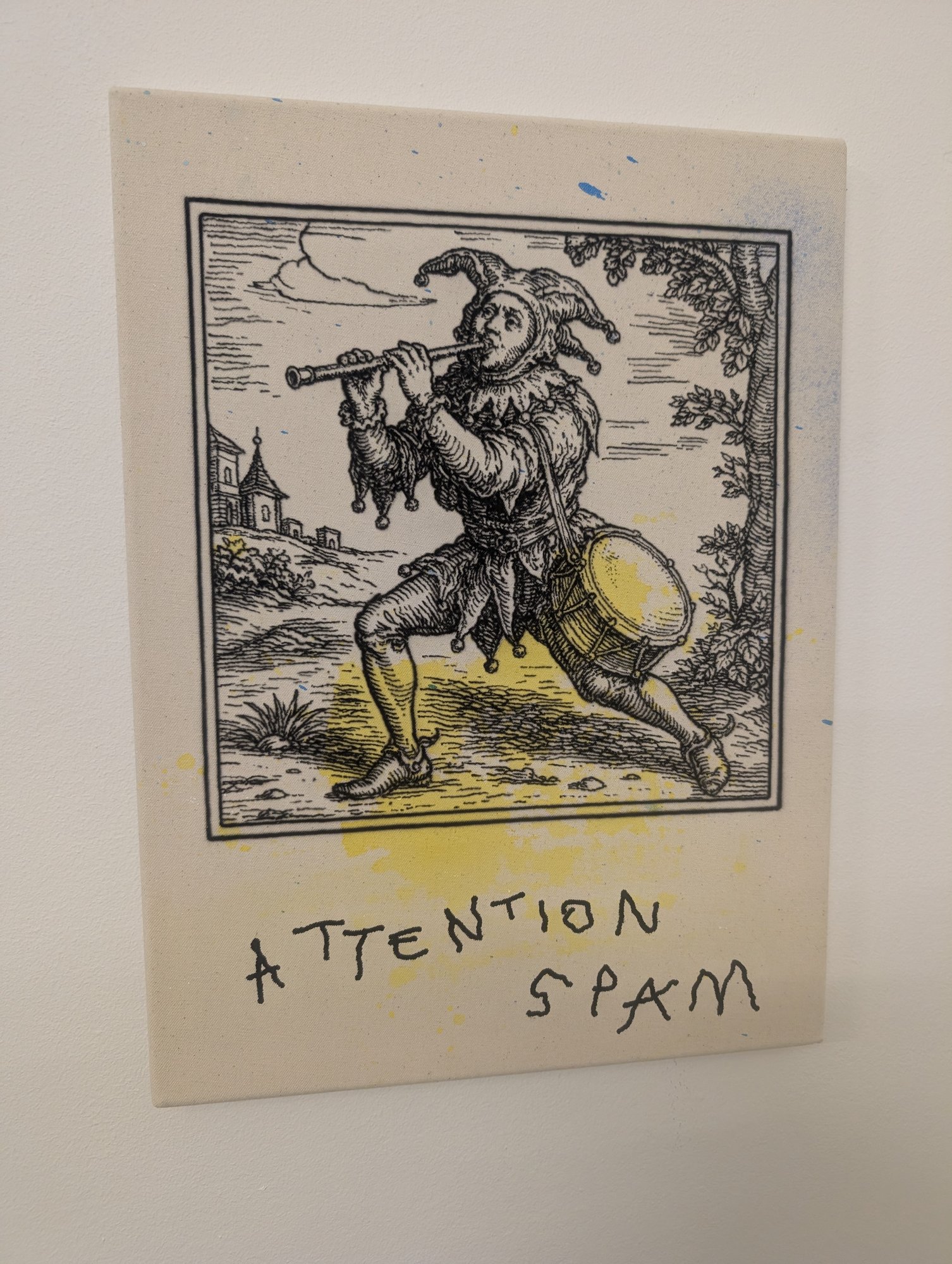
A fool in a belled cap plays a transverse flute, a drum slung at his hip. The woodcut has been reproduced on a small canvas and spattered with yellow and blue, and beneath it, in wobbly capitals, runs the line "ATTENTION SPAM". Swap one letter and the attention span turns into junk mail, with the fool supplying the noise. The picture hung in "BEL ÉTAGE" at BACKSPACE, a show that closed on 13 September, the last day of Berlin Art Week, and it sums the exhibition up better than its title does. The show was at its best where the art mocked the business that had put it in a hall for three days.
A bel étage is the grand first floor of a townhouse. BACKSPACE is nothing of the kind. It isn't a gallery either. It is an events venue in a light-industrial yard: a concrete underpass, a sawtooth-roofed hall, yellow-and-black impact markings on the corner, air-conditioning units on the building opposite and a light box with the name above the door. Inside are white trusses, exposed pipes, two grey air heaters under the roof and strip lights. It is a temporary show that makes no attempt to hide the fact. The poster at the entrance names three galleries, Anja Knoess, Leuenroth and Evelyn Drewes, and works by Jan Dörre, Tom Freitag, Lennart Grau, Beate Höing, Lara Kaiser, Helena Parada Kim, Achim Riethmann, Kinki Texas and Susanne Wurlitzer, plus a contribution titled LAB with further participants. According to the labels, the small watercolours and the painted glass pictures are by Achim Riethmann, represented by Evelyn Drewes.
In the corridor, under a long band of steel-framed windows, six pictures hang in a row, from about 50cm to just over one and a half metres. Four are monochrome reliefs in mauve, grey-green and grey-brown, the paint laid on in thick loops and ridges. Two are figurative, painted in pink, cream and blue with soft gradients: figures whose faces vanish under a broad, glossy swirl of paint. The reliefs repeat that swirl with no face beneath it. Because the six hang side by side, you can see how little of a portrait needs to survive for the gesture to hold.
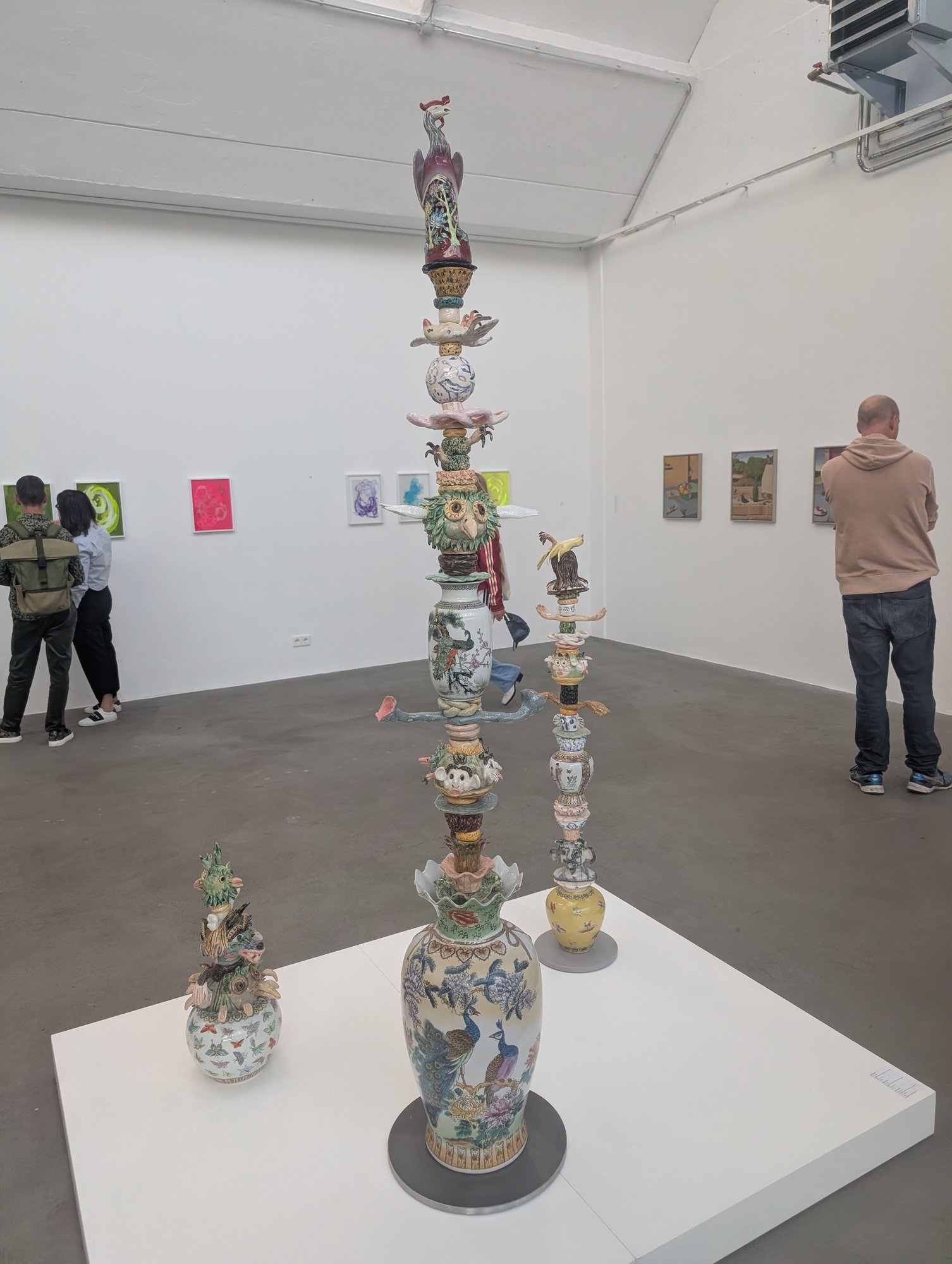
Out in the hall, porcelain towers rise from a low platform, the tallest up to two and a half metres. At the base are bulbous painted vases with peacocks, blossoms and butterflies. Stacked on top are cockerels, an owl's head with wings, hands and flower bowls, all glazed to a high gloss in blue and white, green, pink, yellow and gold. The vases look found, the additions above them modelled by hand and freshly assembled, and the engineering looks optimistic. Ornamental china becomes the base of a totem pole, and the joke works because it is brave enough to go that high. Round the walls hang small paintings, prints and works on paper in neon green, pink and blue, along with one large, crowded picture of figures, traces of writing and boats.
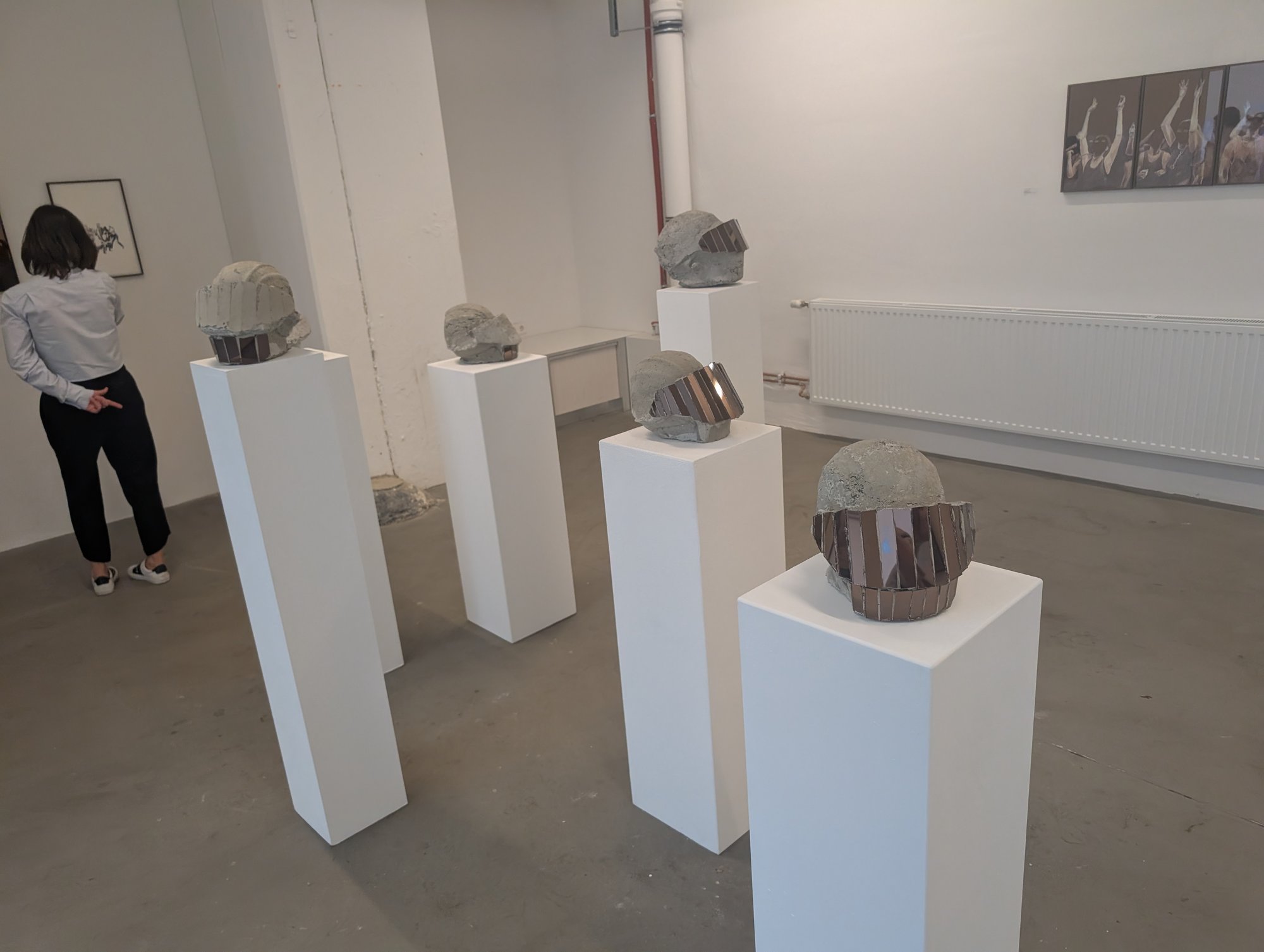
A side room holds five identical tall plinths. On each rests a lump of raw concrete or stone, rounded like a head, with fanned, brownish-tinted mirrored fins fixed to the front like a visor. They read as helmets without wearers, and the fins pull the whole room into the object. On the wall beside them is a triptych of framed sepia photographs of people with their arms in the air. Side by side they make a pair, a cheering crowd on the wall and next to it heads that give nothing away. There is also a loosely hung row of small watercolours of figures on stilts and painted glass pictures by Achim Riethmann, such as "Festival 5", 2026, watercolour on paper and lacquered glass.
And then there are the works that talk. A text painting in neon pink on a gridded ground reads: "Ultimate horror often paralyses memory in a merciful way". A hand-lettered canvas signs off with "SEE YOU LATER, CURATOR". And the fool keeps piping for an attention that the line beneath him has already turned into spam. These are pictures with big mouths. They land because the show they hang in has only three days to be seen.
As an exhibition, "BEL ÉTAGE" is more sampler than argument. The reliefs, the porcelain towers and the concrete helmets share neither material nor subject. What connects them is the venue. That is no crime when three galleries share a venue, but it leaves a string of good moments rather than a whole. The loudmouths are what hold it together. For three days the art business makes fun of itself here, and then it packs up again.
"BEL ÉTAGE" was at BACKSPACE, Berlin, from 11 to 13 September, after an opening on 10 September at 6pm.
Photographs: Florian Jäger, 13 September 2026.
Impressions