Published on
Close Enough & After Nature Prize. Closeness Is Not a Distance
by Florian Jäger
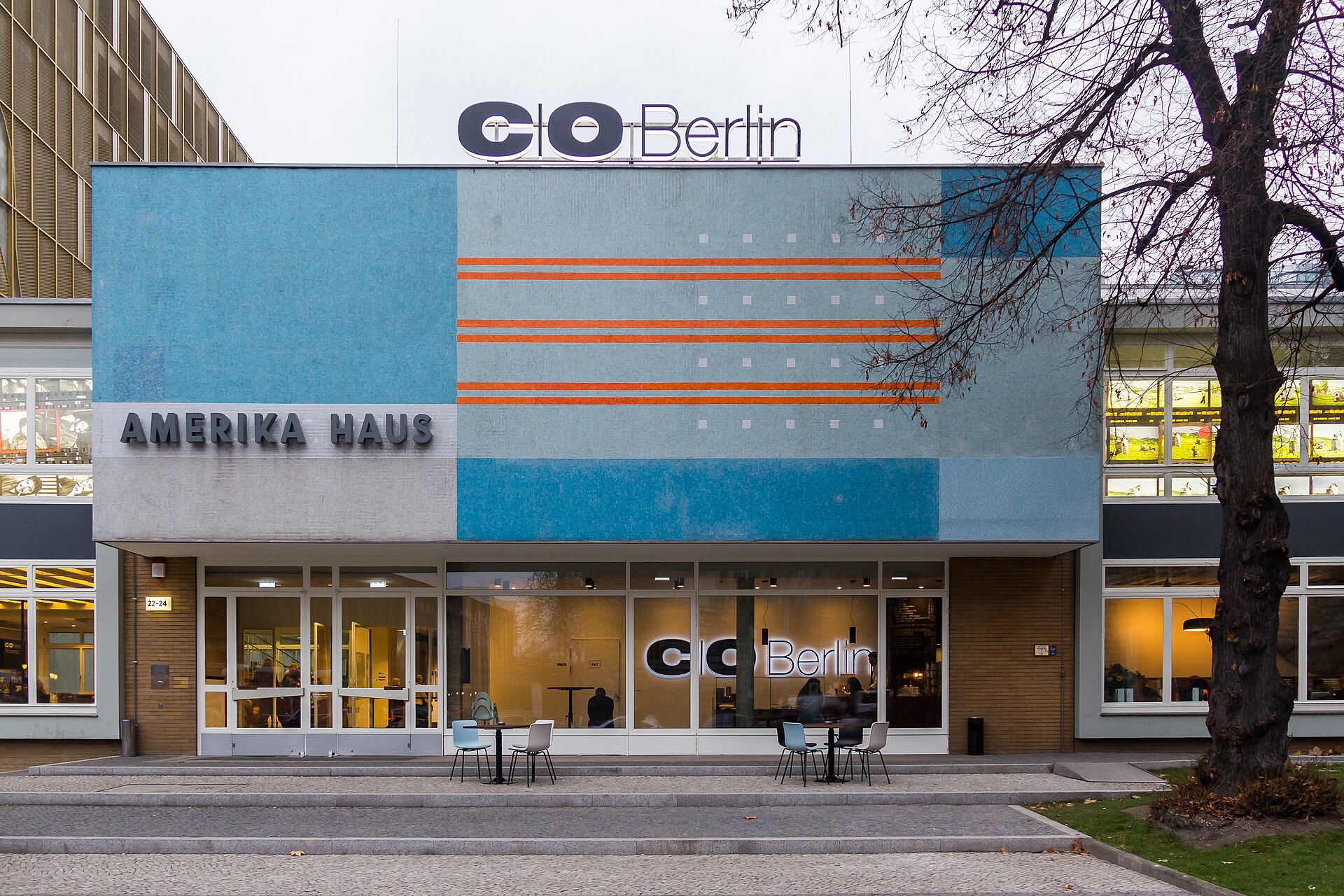
Amerika Haus in Berlin-Charlottenburg, home of C/O Berlin since 2014. Photo: Raimond Spekking, CC BY-SA 4.0, via Wikimedia Commons
Hannah Price photographs men who had catcalled her in the street. She went up to them afterwards, and the harassment turned into a portrait. That is what closeness means in "Close Enough": not a short distance from the action but a relationship someone has to build out of trust, complicity and connection.
Five days before the end of the run, C/O Berlin had three exhibitions on a single ticket, all framed by the institution's 25th anniversary. It started out in 2000 at the Postfuhramt and has been based at Amerika Haus since 2014. "Close Enough" brought together 12 women photographers from Magnum Photos: Olivia Arthur, Myriam Boulos, Sabiha Çimen, Bieke Depoorter, Carolyn Drake, Nanna Heitmann, Susan Meiselas, Cristina de Middel, Hannah Price, Lúa Ribeira, Alessandra Sanguinetti and Newsha Tavakolian. The idea came from the photographers themselves. Charlotte Cotton curated the show at the International Center of Photography in New York in 2022, for Magnum's 75th anniversary, and Boaz Levin adapted it for Berlin. Here it ran into a second anniversary: 25 years since C/O Berlin opened, in 2000, with a Magnum exhibition.
The title quotes Robert Capa: if your pictures aren't good enough, you're not close enough. The exhibition takes the line and questions it in the same breath. There is no overarching thesis, and each body of work keeps its own language. That is risky, since 12 separate hands without a shared question can easily turn into a mere showcase. It works here anyway, because several projects want to know, each in its own way, who decides what a photograph says about a person.
Bieke Depoorter hands the question on. She asked people she met by chance in Egypt to write their own view of the images in her book dummy directly onto the photographs, so their comments literally sit on top of the photographer's gaze. Cristina de Middel gathers accounts from 99 men and one woman who pay for sex, across 10 cities. The ratio alone tells you something. Susan Meiselas turns to photography itself, tracing over decades how the Dani of the Baliem Valley in Papua have been pictured. That work was not in the New York version.
For Alessandra Sanguinetti and Nanna Heitmann, closeness comes with time. Sanguinetti met Guille and Belinda in 1998, three hours south of Buenos Aires, when they were both nine. Heitmann puts two long-term projects on Russia on either side of a leporello. Sabiha Çimen documents a Turkish Qur'an school for girls in 30 photographs.
Alongside, the institution showed the two laureates of the After Nature . Ulrike Crespo Photography Prize 2025, curated by Katharina Täschner. It has been awarded jointly with the Crespo Foundation since 2024. You cannot simply apply: a panel nominates artists and asks them to submit.
In "You Only Look Once", Lisa Barnard starts from echolocation and from Thomas Nagel's question of what it is like to be a bat. The title is the name of a real object-recognition algorithm. The work is anchored at the Salton Sea in Southern California, a military test site in the Second World War and now the scene of lithium recovery and technological promises of salvation. Photographs share the rooms with an immersive video installation, interventions in archives and AI-assisted image analysis.
Isadora Romero's "Notes on How to Build a Forest" looks at two Ecuadorian cloud forests in three sections, including the Chocó Andino de Pichincha biosphere reserve. Documentary photographs sit next to experiments with plants and textiles, pictures from family archives changed by the forest's humidity, and infrared and UV images that try to approximate how the forest's animals perceive. The stated concern is knowledge handed down, including that of the Yumbo and Jama Coaque, and a view of the forest that reduces it neither to deforestation nor to carbon storage nor to the Western idea of untouched nature.
The shows did share more than a ticket. "Close Enough" asks how close one person may get to another, while Barnard and Romero want to know how a bat, an algorithm or the animals of a cloud forest perceive. And an institution that opened with Magnum marked its quarter-century with an exhibition that doubts Capa. There are worse ways to celebrate a birthday.
"Close Enough" and the After Nature . Ulrike Crespo Photography Prize 2025 exhibition were at C/O Berlin, Amerika Haus, Berlin.