Published on
Dominique Horwitz. Faust at the Blackboard
by Florian Jäger
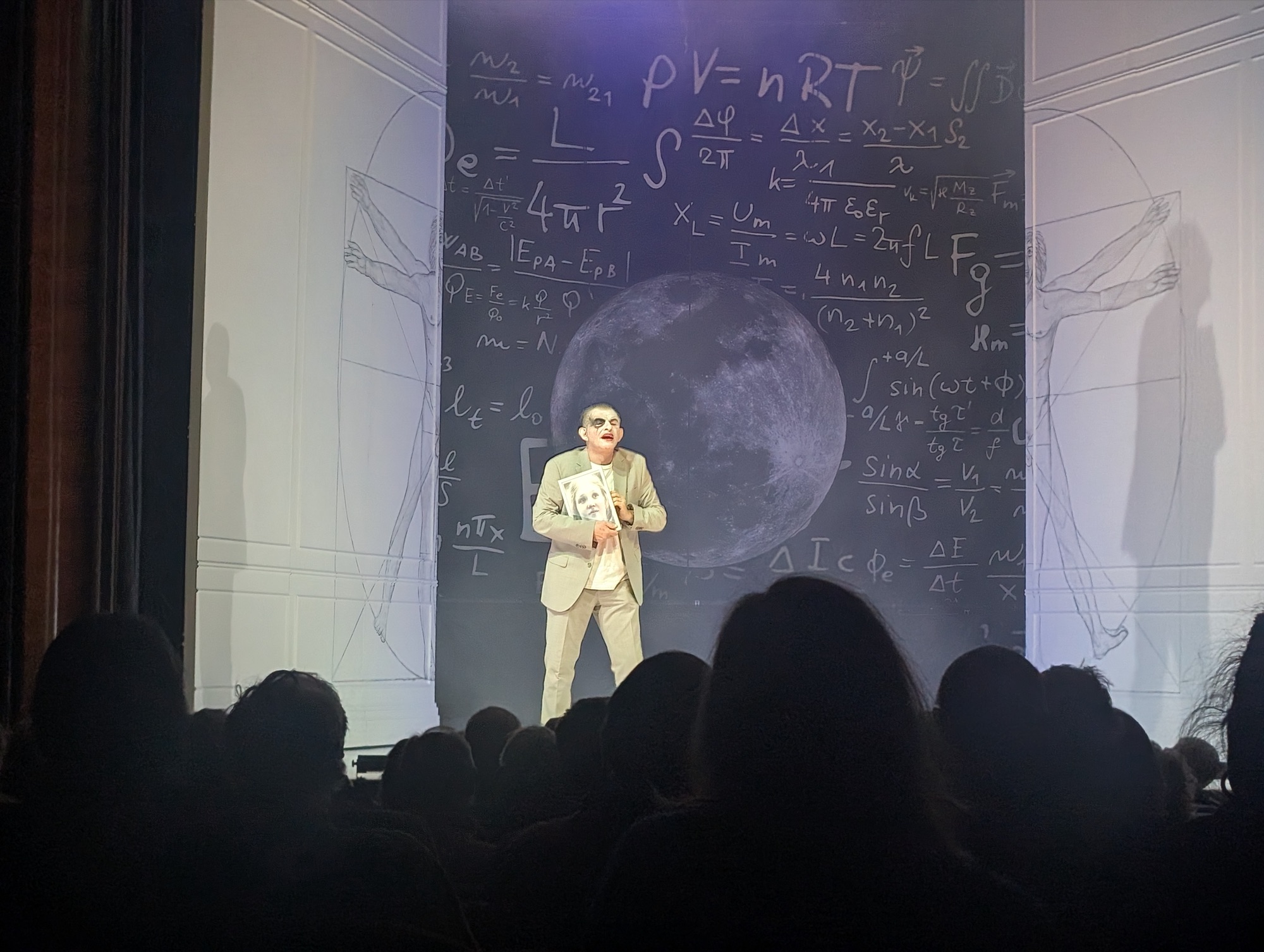
Dominique Horwitz in "Herr Teufel Faust" in front of the blackboard of formulas and the moon, Renaissance-Theater Berlin. Photo: Florian Jäger, 27 October 2026
Behind the man in the pale suit is a blackboard covered in formulas. You can make out the gas law pV = nRT, an integral, Snell's law with sin α over sin β, and in the middle hangs a photograph of the full moon. Leonardo's Vitruvian Man is sketched in thin lines on the white side walls. The man in front has his face painted white, one eye ringed in black and his lips red, and he is pressing a black-and-white photo of a young blonde woman to his chest. This is Dominique Horwitz in "Herr Teufel Faust" ("Mr Devil Faust"), and the idea of the evening is already in this one scene. His Faust wants to capture the world in equations, and he holds love in his hand as a photograph.
Torsten Fischer adapted the text from Goethe's "Faust I" and also directs, with designs by Herbert Schäfer and Vasilis Triantafillopoulos. Horwitz is alone on stage and switches between the characters for a good hour and a half, interval included. The production opened in September 2024 at the Stadttheater in Minden. Since then it has toured as a guest production of the Konzertdirektion Landgraf, and in 2025 it won the INTHEGA prize "Die Neuberin", awarded by the German towns that host touring theatre. The announcement promises an arc from Gretchen to colonialism, industrialisation and the Anthropocene, which takes it into territory that Goethe only reaches in Part Two, or never.
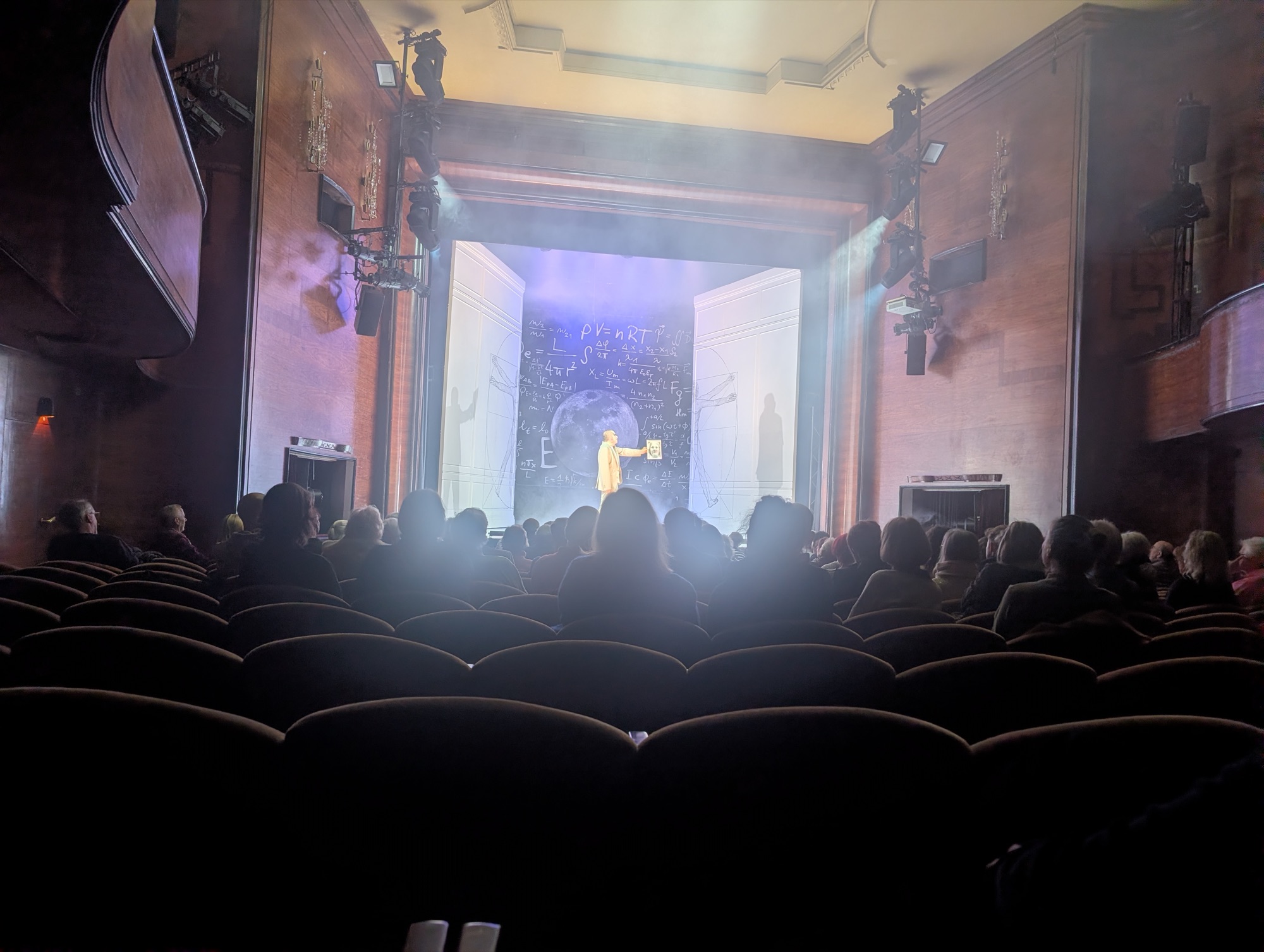
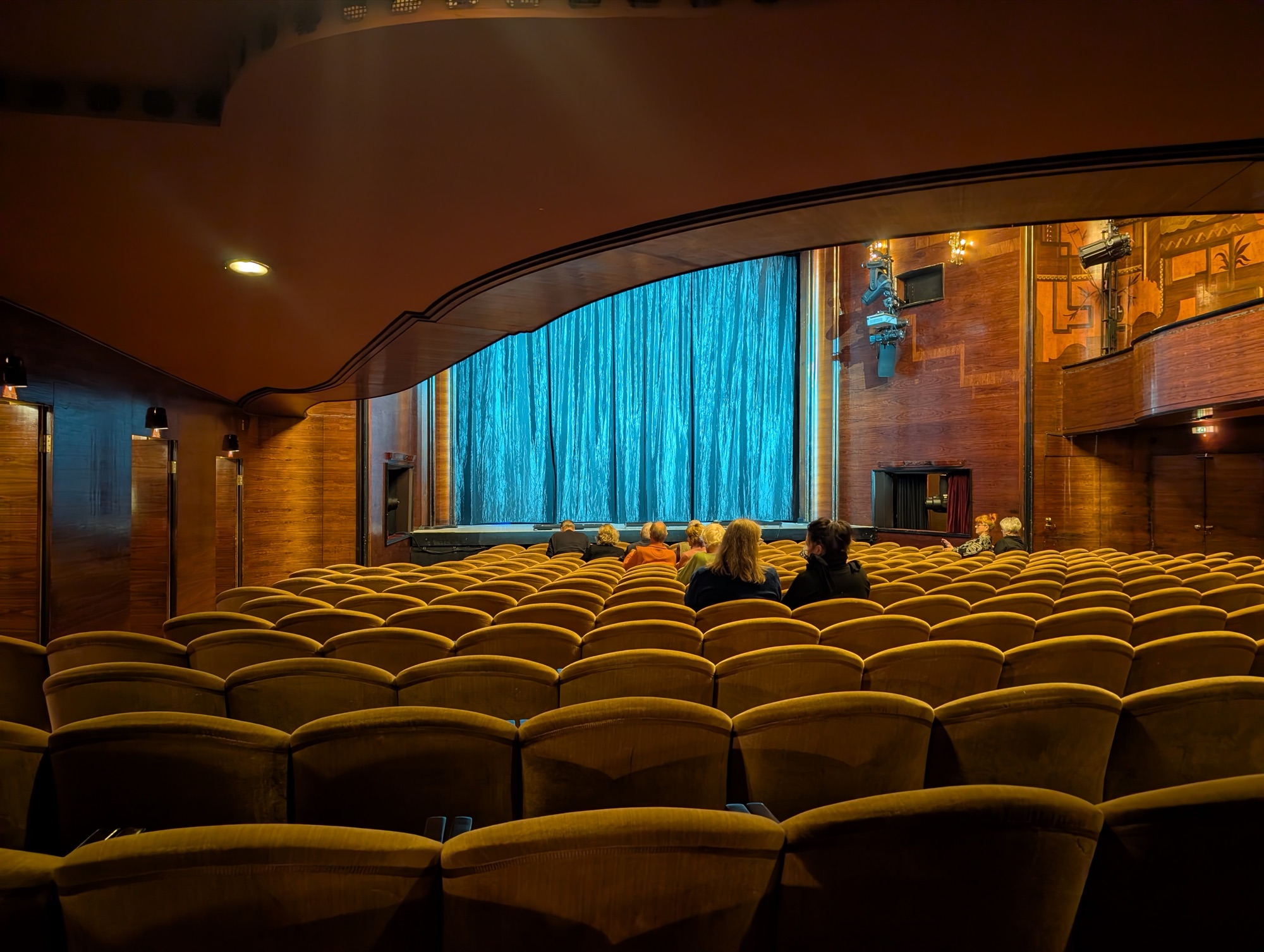
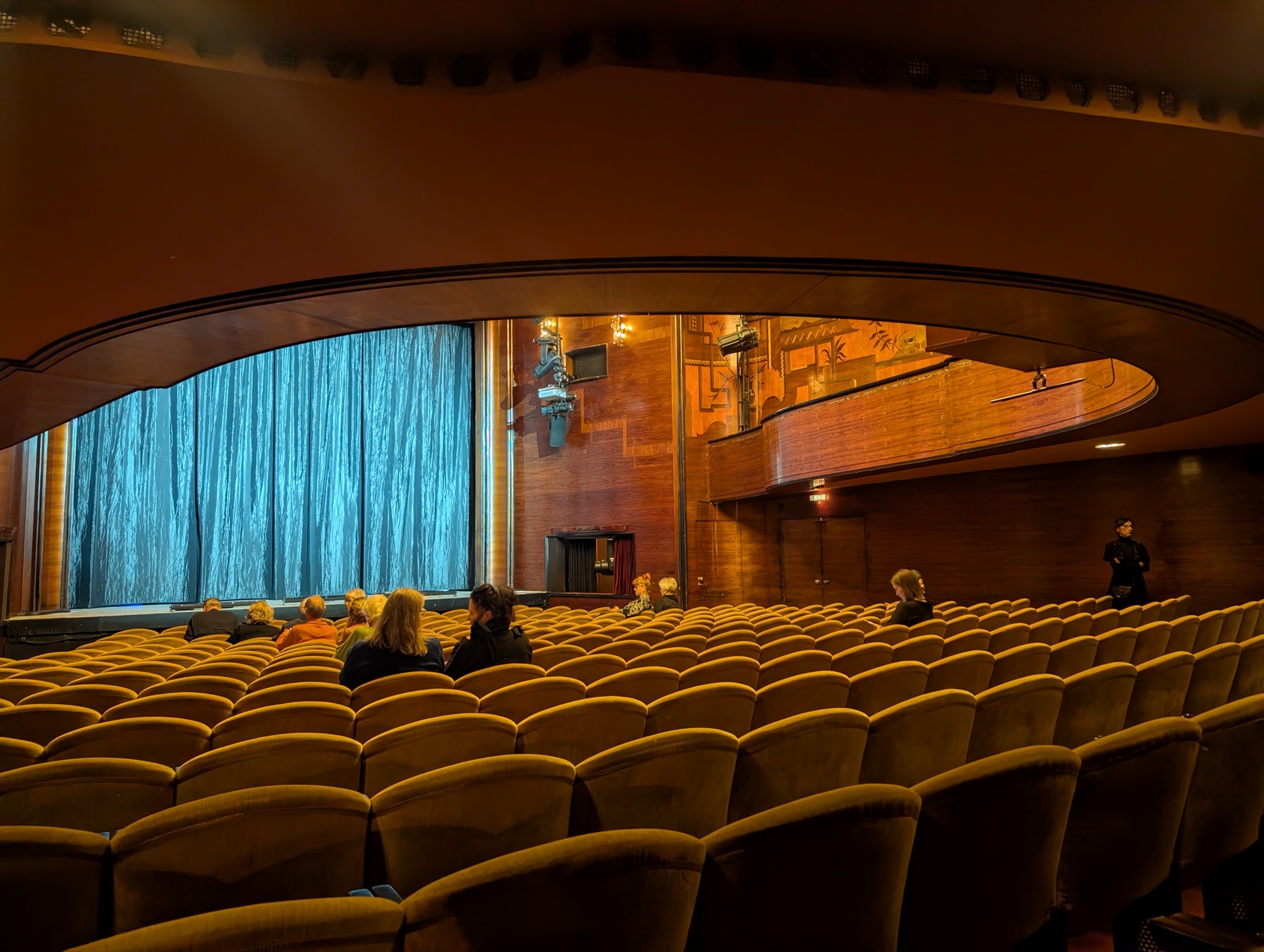
On its tickets, the Renaissance-Theater calls itself the last fully preserved Art Deco theatre in Europe. The 1926 auditorium is lined with dark, figured wood, the balcony walls carry inlays of plants and geometric patterns, and the seats are upholstered in ochre velvet. Before the show a blue curtain with a crumpled sheen hangs in front of the stage. When it opens, there is a white, coolly lit box behind it with two angled walls, and light falls from above through haze. The set was built for touring, for civic halls in Minden, Worms or Göppingen. In this auditorium it looks like a laboratory someone has put down in a drawing room.
If anything, the mismatch helps the play. At the start Faust wants to get out of his study, and here he is shut in twice over, inside the white box and inside the wood-panelled hall around it. The formulas on the board are no sorcery either. They are textbook physics, gases, light, oscillations, with the moon hanging among them that none of the equations explains.
Horwitz wears the devil of the title on his face. The white make-up with the blackened eye looks like half a mask, as if Mephisto had taken hold of Faust before any pact was made. For a solo show this is a smart move, since one face is enough to switch between two characters without anyone leaving the stage. Reviews from the tour single out exactly these switches, and the Acher- und Bühler Bote wrote in April: "He doesn't play Faust, he is Faust."
So the evening rests on two things, an actor and a set you remember. That the white box stands in the wrong building only makes it stronger. A Faust who wants out of his study is most convincing in a room where he doesn't belong.
"Herr Teufel Faust" with Dominique Horwitz, a guest production by Konzertdirektion Landgraf, is at the Renaissance-Theater, Knesebeckstraße 100, Berlin, until 31 October.
Impressions