Published on
Grace Weaver. Same Stage, Different Gesture
by Florian Jäger
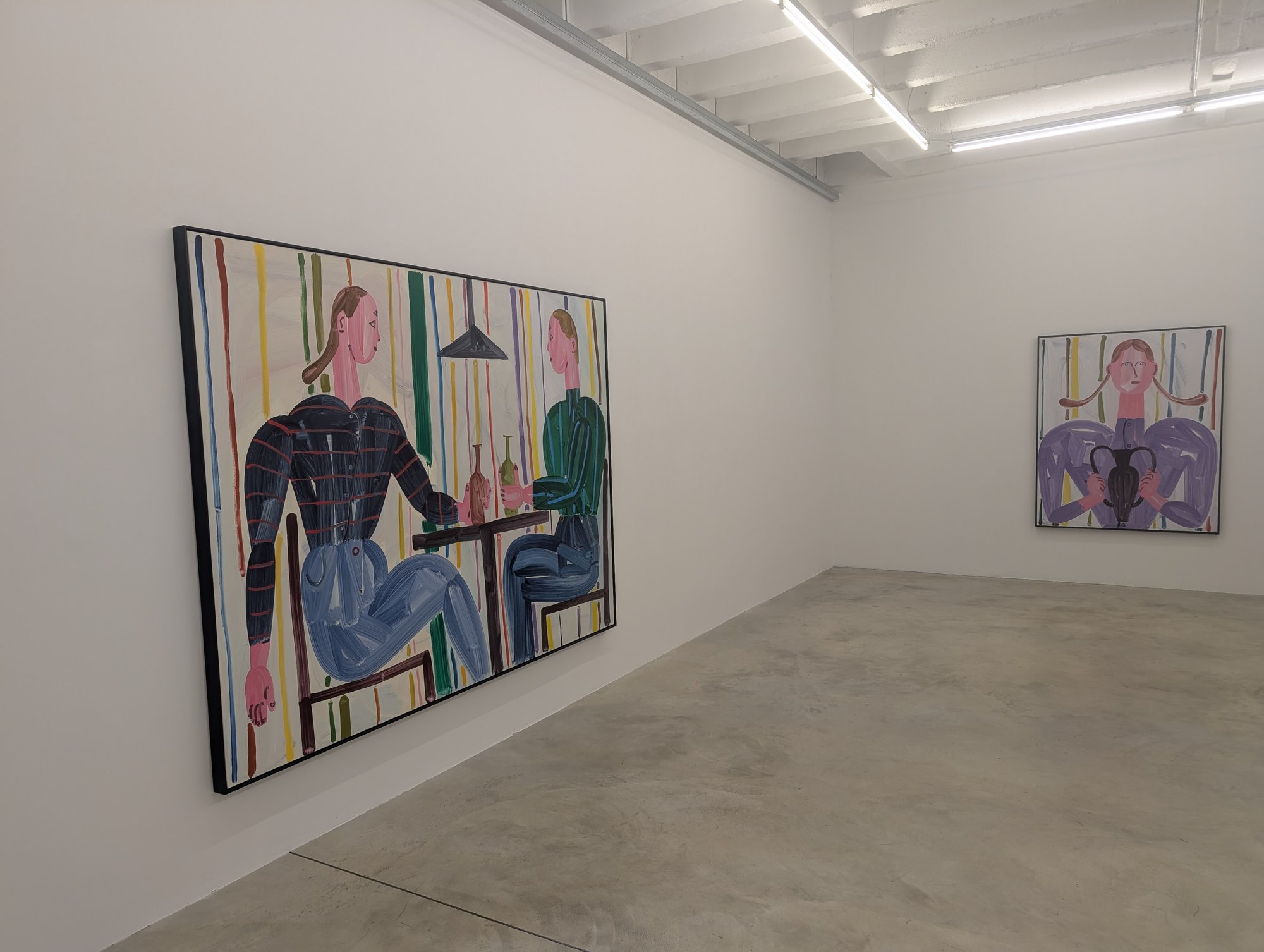
Grace Weaver, "Parataxis", at Soy Capitán: two figures at a table, left, and a figure holding an amphora, right. Photo: Florian Jäger, 13 September 2026
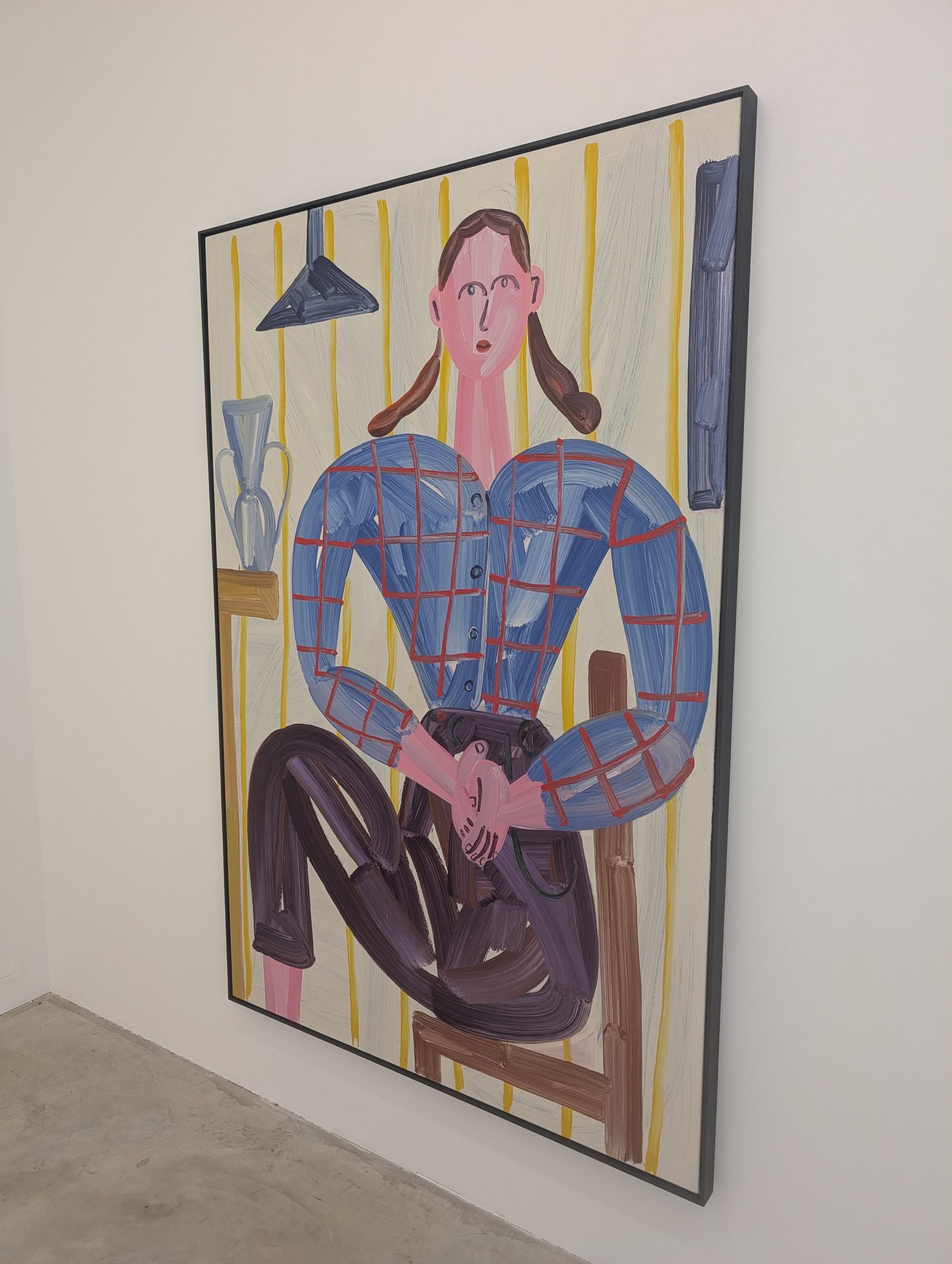
The figure does not fit its chair. Arms and knees push against the edges of the canvas, two plaits jut out and down at an angle, and the face is four lines. The canvas hangs in "Parataxis", Grace Weaver's exhibition at Soy Capitán on Lindenstraße, which has been running since 4 September. Weaver paints figures too big for their pictures. She puts them on the same stage again and again, and the whole show lives off that repetition.
The body is made of single broad brushstrokes, and every one can be followed. The bristle marks stay visible, and where a stroke stops, the paint sits in a ridge. Because you can see where each mark begins and ends, the figure looks less painted than assembled, like a chair built from a few parts. Behind it is a cream ground with vertical yellow stripes, with a pale blue two-handled amphora on an ochre shelf to the left and a dark blue conical lamp above.
Round the corner the same props turn up again. A large horizontal canvas shows two figures in profile at a small dark table, each holding one of two bottles. Another conical lamp hangs overhead, and the ground is striped again, this time in red, yellow, green, blue and violet. Beside it, much smaller, a frontal figure in violet holds a dark two-handled amphora in both hands, its plaits this time sticking straight out sideways. The lamp and the amphora stay, and only the gesture changes. The table scene is domestic in set-up but built in such strict symmetry that it looks more like a ceremony. On the shelf the amphora still passes for decoration. In the violet figure's hands it looks like something meant for a ritual.
In grammar, parataxis means setting clauses side by side, with none subordinate to another, and that is how the exhibition is hung. Each painting hangs alone, far from the next, all at the same centre height, in thin dark shadow-gap frames that vanish from two metres away. No painting explains another, so you make the connections yourself as you walk. The room is a white cube that makes no secret of where it came from. The ribbed ceiling is rough and painted white, with a galvanised steel rail and exposed pipework, and below it are two long light strips and polished concrete with a visible expansion joint.
According to the bilingual text on the front desk, Soy Capitán and Galerie Max Hetzler are showing the exhibition jointly in their Berlin spaces. Hetzler is at Bleibtreustraße 45, on the other side of the city.
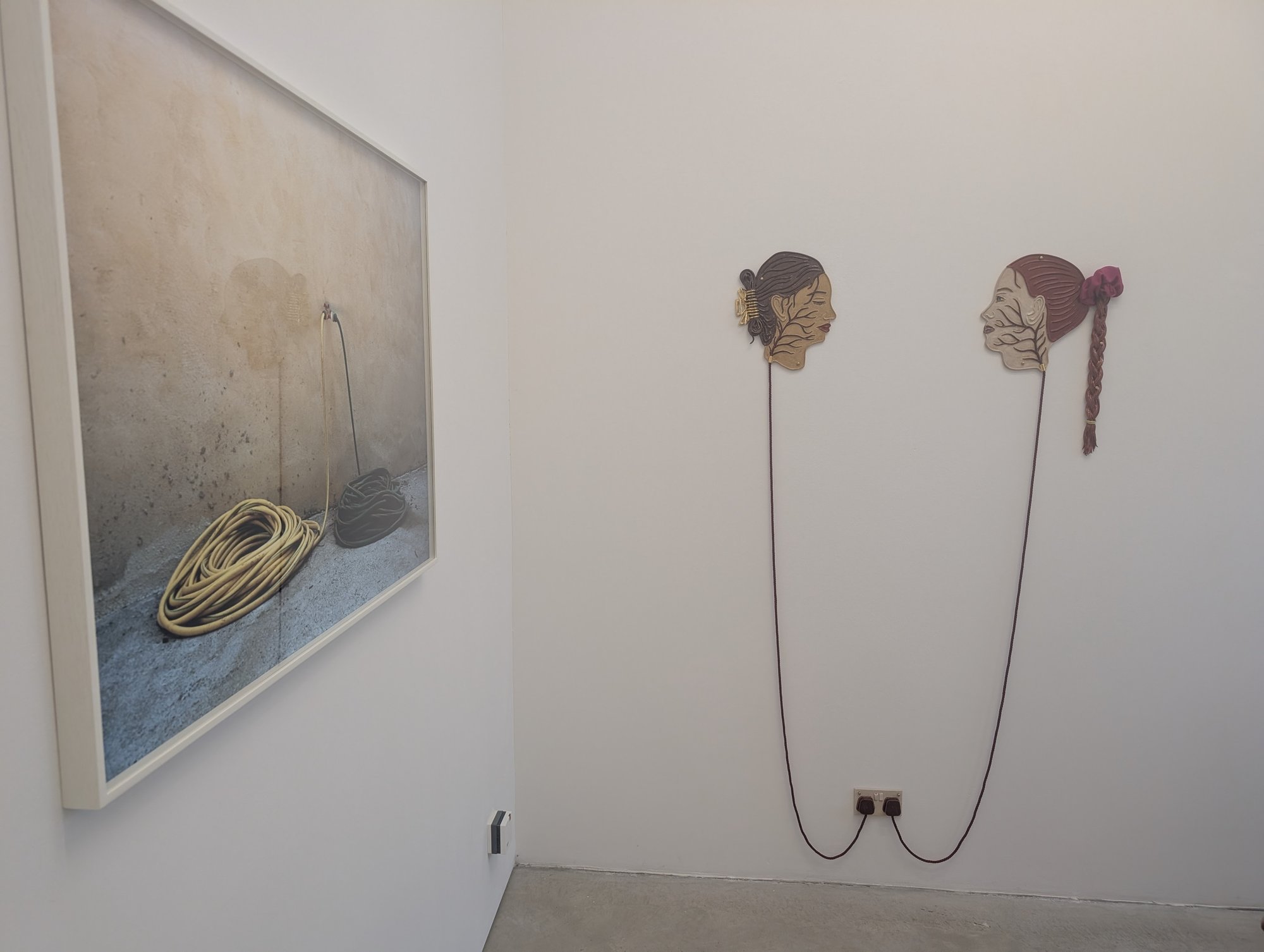
In the next corner hangs something that does not belong to this painting. Two flat profile heads apparently in clay face each other, one with a gold clip in its hair, the other with a real plait hanging loose down the wall. From each head a fabric-covered cable loops down to a socket just above the floor, so the building's wiring becomes part of the composition. Beside them are a glazed relief and a framed photograph of a coiled yellow hose against a concrete wall, and hose and cables rhyme. According to the list of works, the table scene shares the show's title, "Parataxis", and the figure with the amphora is "Amphora", both 2026. The list covers only six paintings by Weaver, and the heads, the relief and the photograph are not among them.
"Parataxis" is a concentrated show. It makes do with a handful of props and repeats them until you notice nothing but the gestures. What gets in the way hangs at the edge. The clay heads, with their real plait and real cables, hang only a corner away and pull the eye from the canvas to the socket. Weaver's figures don't need any of that. A frame one size too small is enough for them.
Grace Weaver, "Parataxis", is at Soy Capitán, Lindenstraße 34, Berlin, until 24 October.
Photographs: Florian Jäger, 13 September 2026.
Impressions