Published on
Martin Margiela and Alan Charlton. Circles Under High Voltage
by Florian Jäger
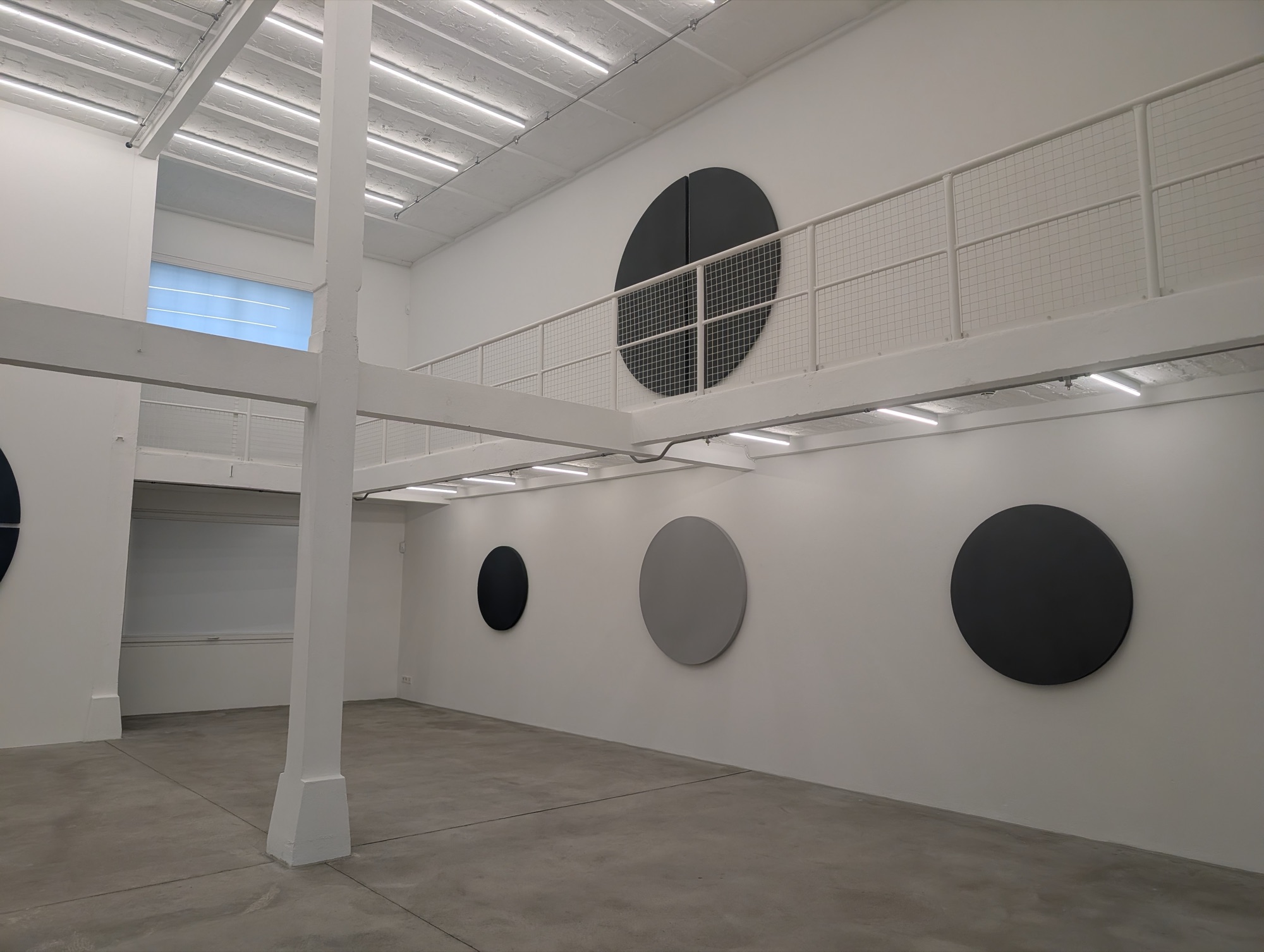
Installation view: round single-colour panels in the two-storey hall at Konrad Fischer Galerie, a halved disc behind the gallery railing. Photo: Florian Jäger, 13 September 2026
A large dark grey disc hangs high on the wall of the main hall, split vertically in two, and the white mesh railing of the upper gallery runs across its lower part. The grid sits over the circle like glazing bars. It is the strongest image at Konrad Fischer Galerie on Neue Grünstraße, where two exhibitions have run side by side since 10 September: Martin Margiela's "Martin Margiela in Berlin" and Alan Charlton's "Circle Paintings". After a walk through the building, one thing stands out: the house is at its strongest where the circles meet its architecture.
The hall rises through two floors. Walls, columns and beams are white, light strips line the rough whitewashed ceiling, and the floor is concrete. On the walls hang round, single-colour panels in dark grey, light grey and blue-black; my photographs show at least five. Two are divided. The big disc up top is halved, and a navy one on the left wall is cut into quarters by narrow joints. Those joints repeat the cross of column and beam that structures the hall, and the discs are the only curves in a room of right angles. Nothing else stands in the hall, so each circle reads as a variation on the last: smaller, paler, split. Here the hang and the architecture work together.
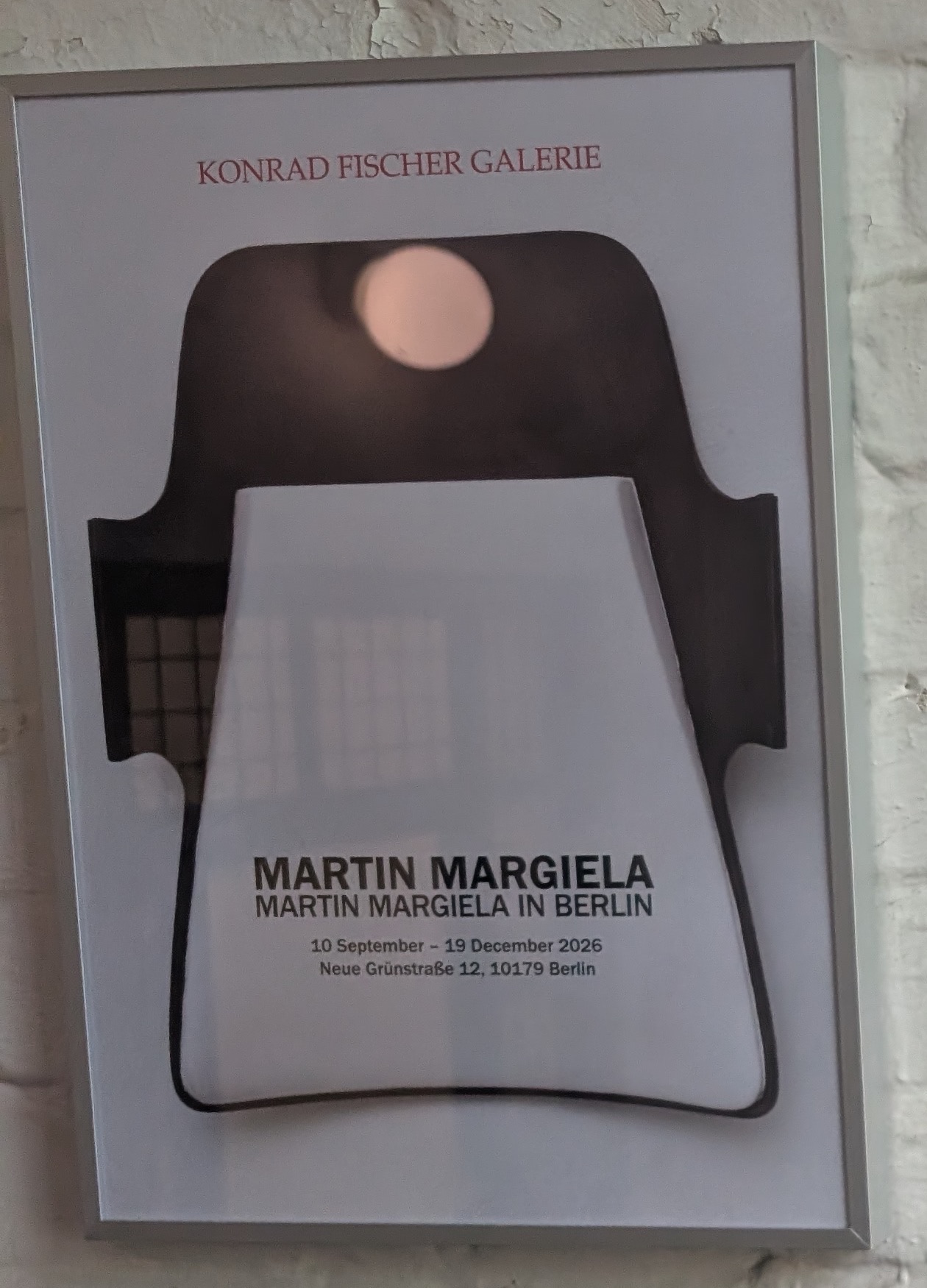
At reception lie white cards reading "CIRCLE PAINTINGS" and dark leaflets reading "MARTIN MARGIELA IN BERLIN", beside a visitors' book and a stand with a QR code "for more information on the exhibition". There will have been labels, but I did not photograph them, so I am not assigning works to either show here. The posters on whitewashed brick offer clues, and what they suggest is inference, not evidence. The Charlton poster shows a dark disc, which fits the panels in the hall. One of two Margiela posters shows a seat shell in dark moulded wood with a white pad.
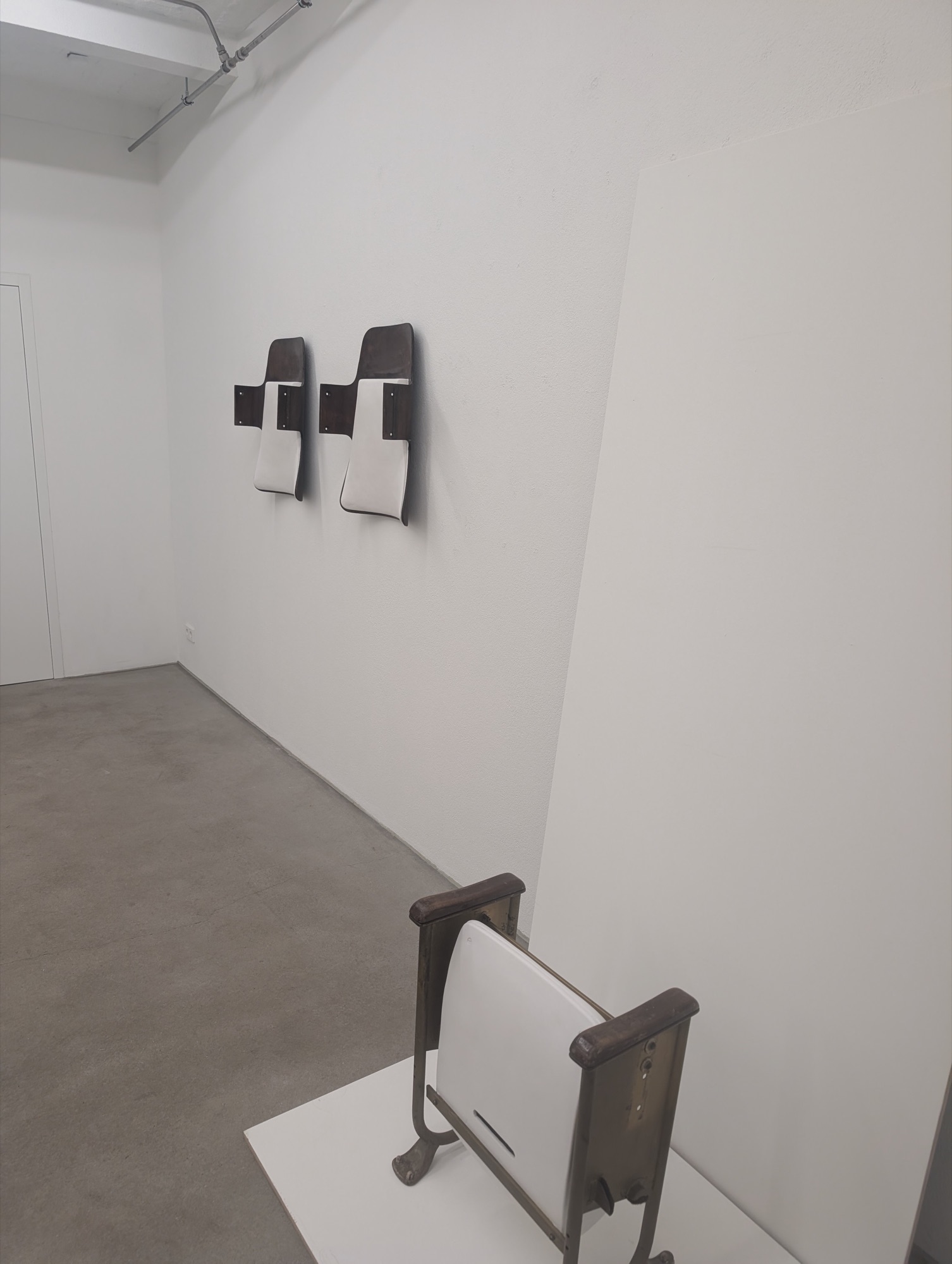
A very similar shell hangs twice on the wall of a side room, its side tabs like mounting brackets. In front, on a white plinth, stands an old folding seat with a metal frame, wooden armrests and a white seat. They look like seats pulled from a row in a cinema or lecture hall. On the wall they become reliefs, on the plinth a sculpture, and nobody is meant to sit down. It is a dry, exact idea. Because the shells match the poster, I would place them in "Martin Margiela in Berlin", though I cannot prove it.
For the other works I lack even that clue. In one room, lengths of grey-brown and cream striped fabric are pinned to the wall. The edges are cut in waves and fraying, two pieces jut out on the left like sleeves, and the stripes buckle with the cloth. Cloth that could have come off an awning is treated like a dress pattern. In another room, a white board carries two round reliefs: underwear twisted into circular frames like embroidery hoops, white and stiff. These are circles too, but made of twisted cloth rather than flat, single-colour surfaces. Even the office joins in, with an octagonal mirror framed by folded layers of colour above a desk with a monitor.
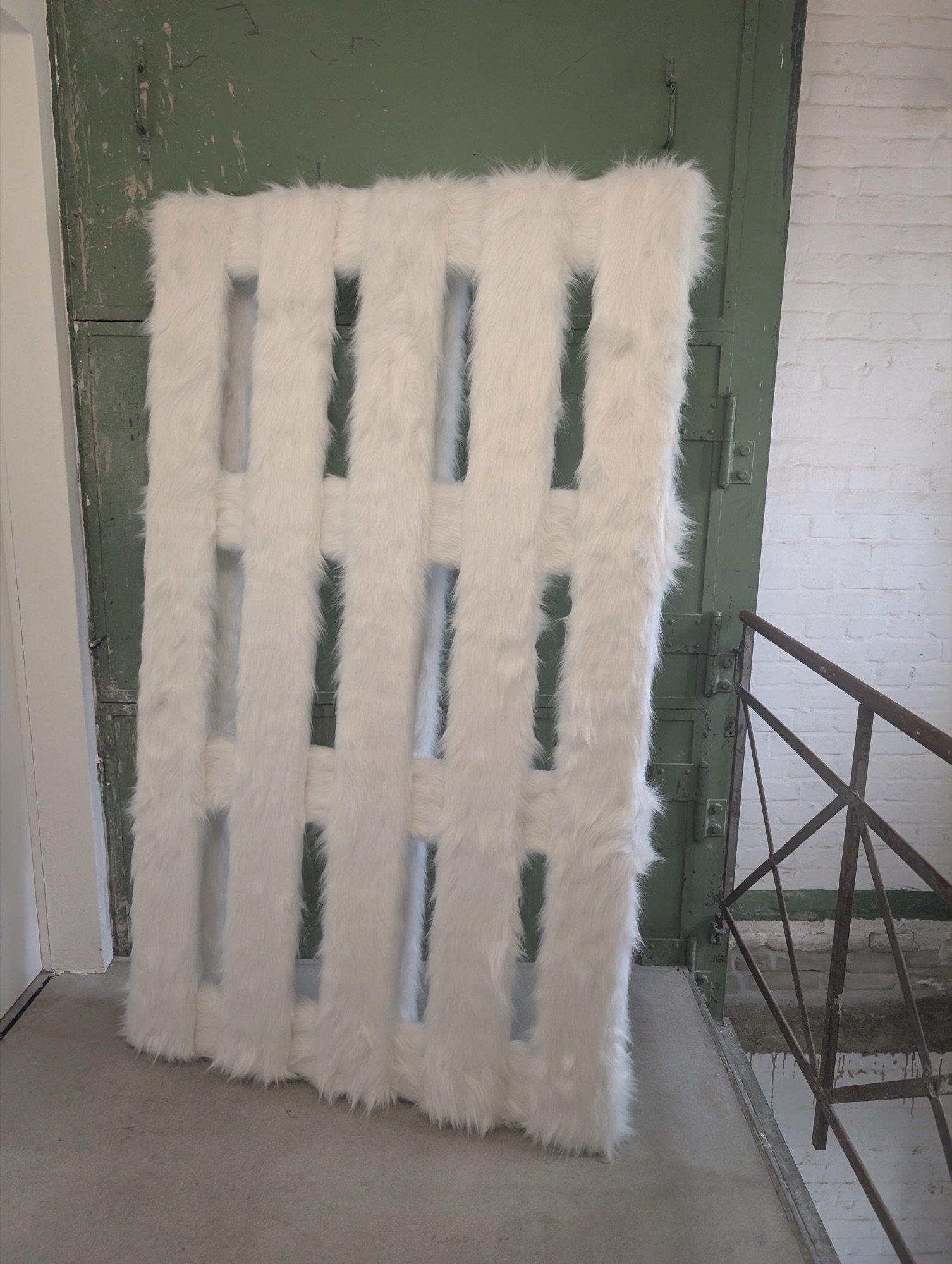
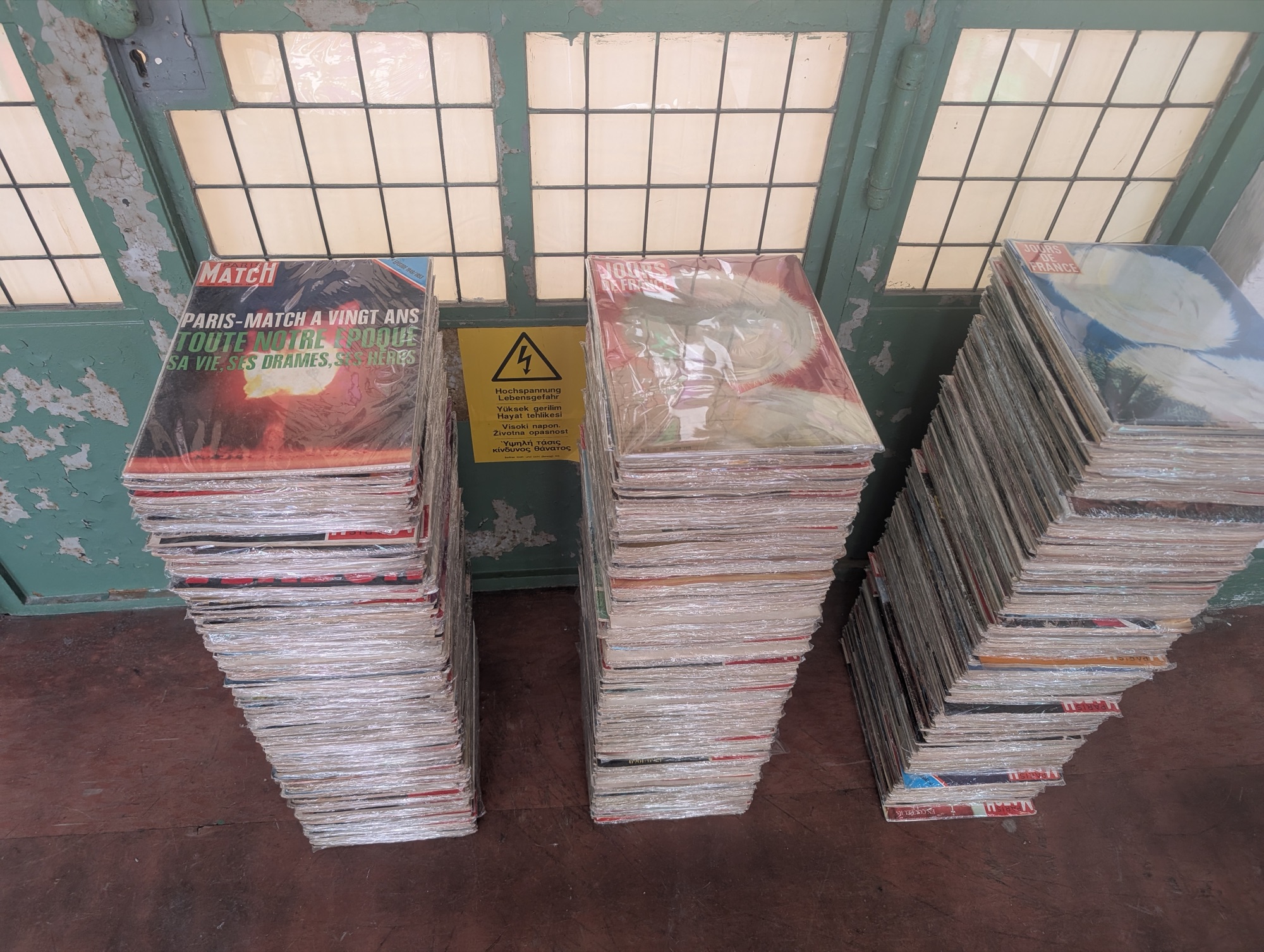
The building has plenty to say for itself. Green steel stairs wind up through whitewashed brick past violet, red, green, yellow and blue panes, and a sign by the riser pipe reads "Löschwasserentnahme für Feuerwehr" ("Water outlet for the fire brigade"). On a landing, a pallet covered in white fake fur leans against a riveted green steel door: soft white against flaking green, one of the best pictures in the house. Against a green steel-and-glass wall stand three tall stacks of individually shrink-wrapped old "Paris Match" and "Jours de France" issues, one topped by "Paris-Match a vingt ans" ("Paris-Match Is Twenty"). Between the stacks hangs a yellow sign warning of high voltage in four languages, signed "Berliner Kraft- und Licht (Bewag) AG". The building was evidently once part of the power supply; the sign says no more.
As a whole, the visit is uneven. The hall convinces because circle, colour and architecture come together unexplained. The rest is rich in material – striped cloth, fur, underwear, seat shells – but scattered across side rooms, an office and landings, and between rooms the coherence the hall achieves so easily gets lost. The building pushes back: stairs, steel doors and the Bewag's yellow warning sign recall that it was once part of the power supply. The circles in the hall hang under that tension, and they hold.
Martin Margiela, "Martin Margiela in Berlin", and Alan Charlton, "Circle Paintings", are at Konrad Fischer Galerie, Neue Grünstraße 12, Berlin, until 19 December.
Photographs: Florian Jäger, 13 September 2026.
Impressions