Published on
Museu Picasso. Beginnings, Not Greatest Hits
by Florian Jäger
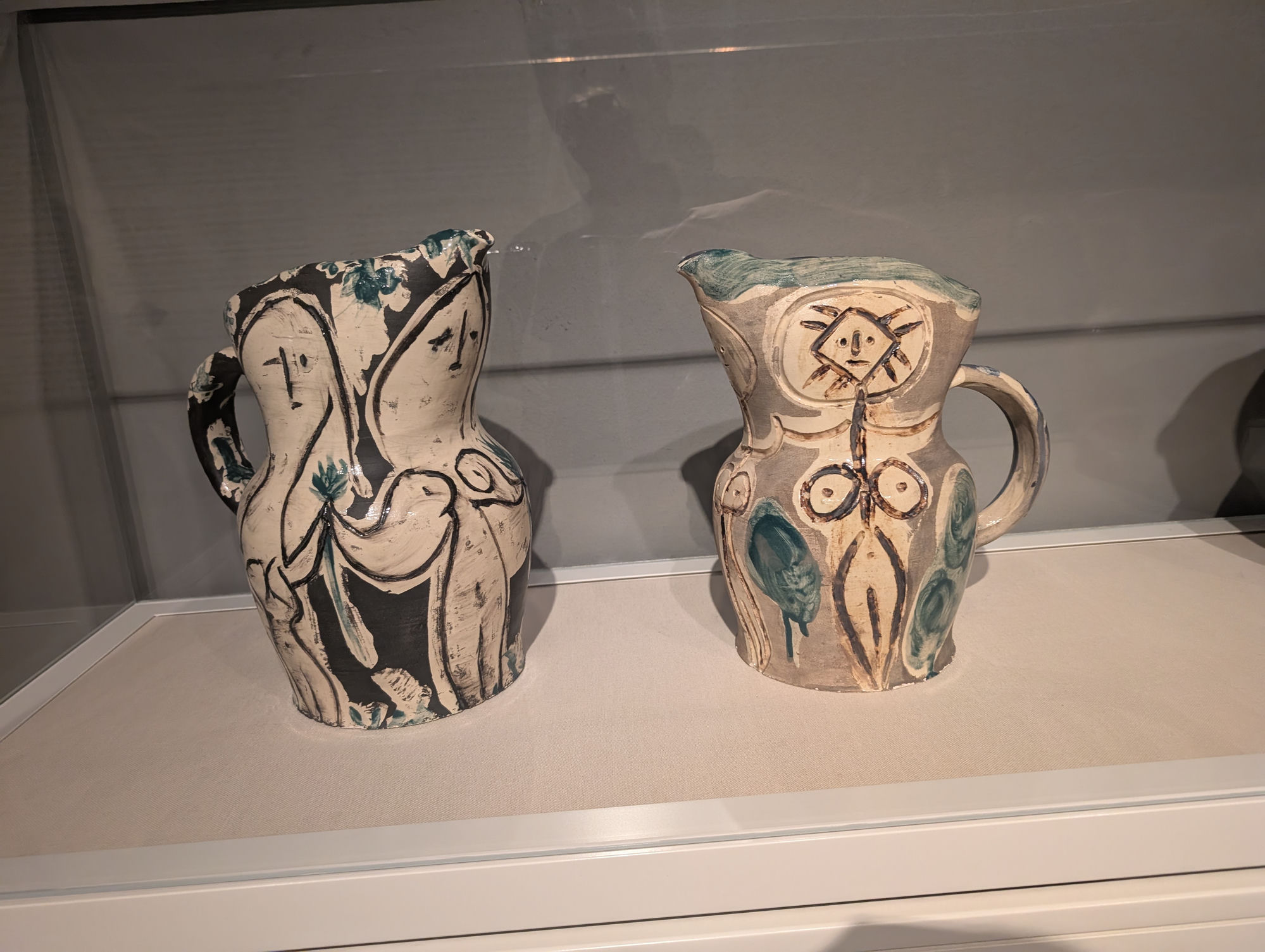
Two anthropomorphic pitchers in the ceramics case at the Museu Picasso on Carrer de Montcada. Photo: Florian Jäger, 1 August 2025
Two pitchers in a display case, both turned into bodies. On the left one, two elongated pale female figures outlined in black stretch across a dark ground. Their heads sit just below the rim, and their bodies swell where the pitcher does. The one on the right has a grey ground. Near the top is a face inside a diamond, ringed with rays and set in a medallion, and below it breasts, a dot for a navel, a torso, with patches of green on either side like leaves. Picasso takes the shape of the vessel and reads it as a figure. The pitchers never quite become sculpture, even though they are no longer really utilitarian forms, and the handle stays a handle.
The case is in the Museu Picasso on Carrer de Montcada, the same narrow lane as the Moco. Anyone expecting the famous paintings has come to the wrong building. The emphasis is on the beginnings. Most of the paintings date from between 1890 and 1917, and the Blue Period is here too. This is a museum about becoming rather than world fame. That makes it more interesting than the greatest-hits museums, because you get to see a painter who is still on his way.
The museum occupies five adjoining Gothic palaces and opened on 9 March 1963. The initiative came from Jaume Sabartés, Picasso's boyhood friend and later his secretary, who had wanted the collection in Málaga. Picasso insisted on Barcelona. After Sabartés died in 1968, the 58 works of the 1957 series on Las Meninas came to the museum. They are the great exception, with the old Picasso working his way through Velázquez.
The other exception is the case on the ground floor. Jacqueline Roque gave the city 41 ceramics in 1982, all of them unique pieces, which Picasso had given her over two decades. They were made at the Madoura pottery in Vallauris in the south of France, where he worked from 1947 at the invitation of Suzanne and Georges Ramié. The gift came as a surprise. It was announced at the opening of a ceramics exhibition for which Jacqueline had only agreed to lend the pieces.
Upstairs at the time was "Créixer entre dos artistes" ("Growing Up Between Two Artists"), a tribute to Claude Picasso set in motion by Paloma Picasso. Through photographs, toys, ceramics and everyday objects it told the story of the two siblings' childhood with Pablo Picasso and Françoise Gilot in Vallauris. For the first time in Spain, Gilot's own painting was given a large room.
The case downstairs and the exhibition upstairs lead to the same place, the same house in Vallauris. A museum of beginnings ends with two pitchers and two children.
Museu Picasso, Carrer de Montcada, Barcelona. "Créixer entre dos artistes" was there from 25 July to 26 October 2025.
Photograph: Florian Jäger, 1 August 2025.