Published on
A Round of Galleries. Three Rooms Without Names
by Florian Jäger
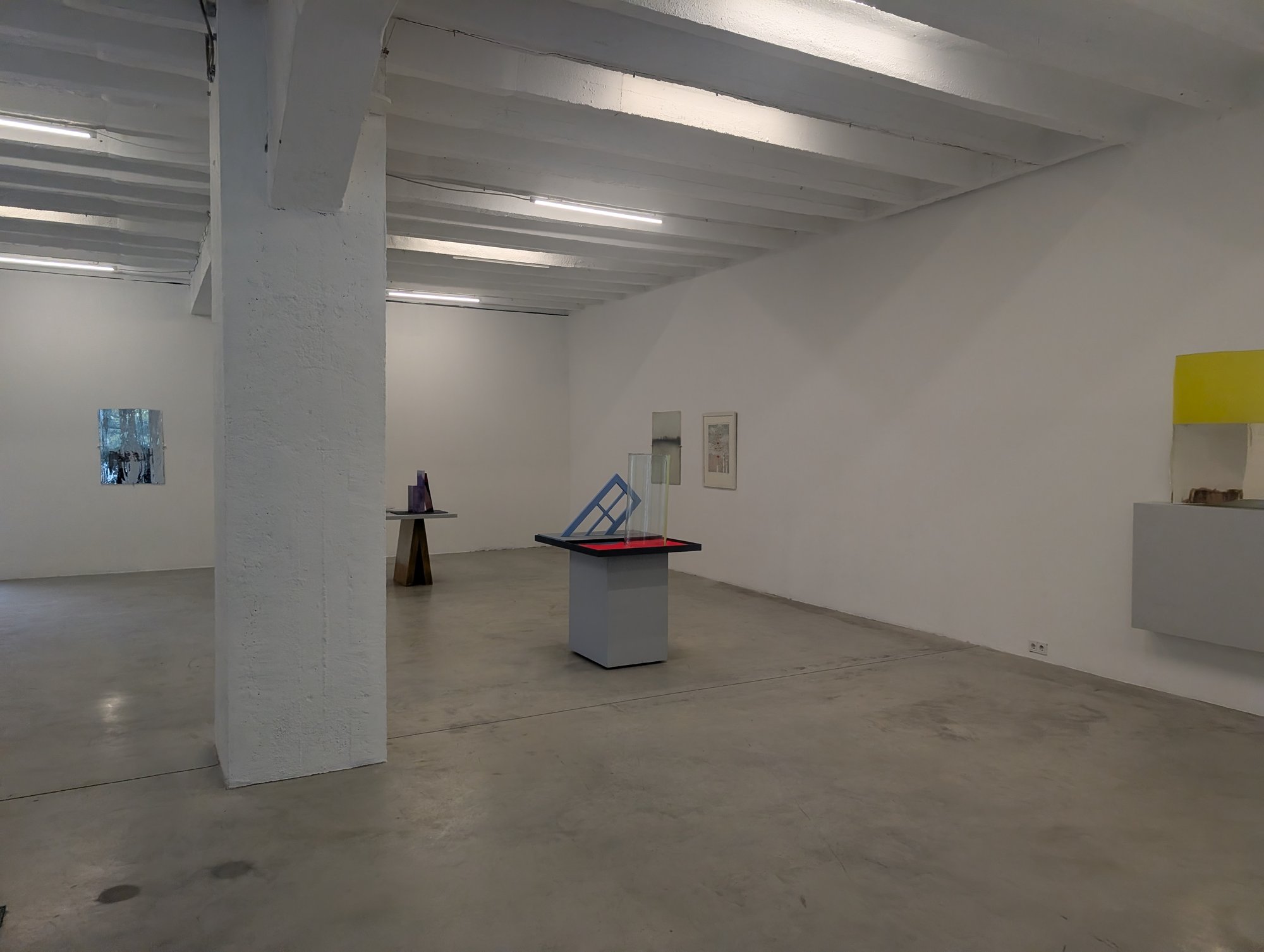
Umgenutzte Etage mit tragendem Mauerpfeiler, Berlin Art Week. Foto: Florian Jäger, 13. September 2026
Sunday 13 September 2026, the last day of Berlin Art Week. Between the stations that can be named, three lay on this afternoon that cannot. In none of these rooms did a label hang, in none was a gallery sheet laid out, on no wall stood a title. I describe them anyway, because they were among the more interesting of the day, and I say so plainly: who is exhibiting here, I do not know.
The first station is a converted floor, not a purpose-built gallery. A load-bearing masonry pillar stands in the middle of the room with its wiring exposed on it, fluorescent tubes hang in rows below a ribbed ceiling, an old house intercom with a handset sits on one wall beside a double socket. The floor is polished concrete with visible joints. A heavy steel staircase with flat-steel railings leads up, and on the upper floor the ribbed ceiling gives way to a tall glazing-bar window with green trees behind it.
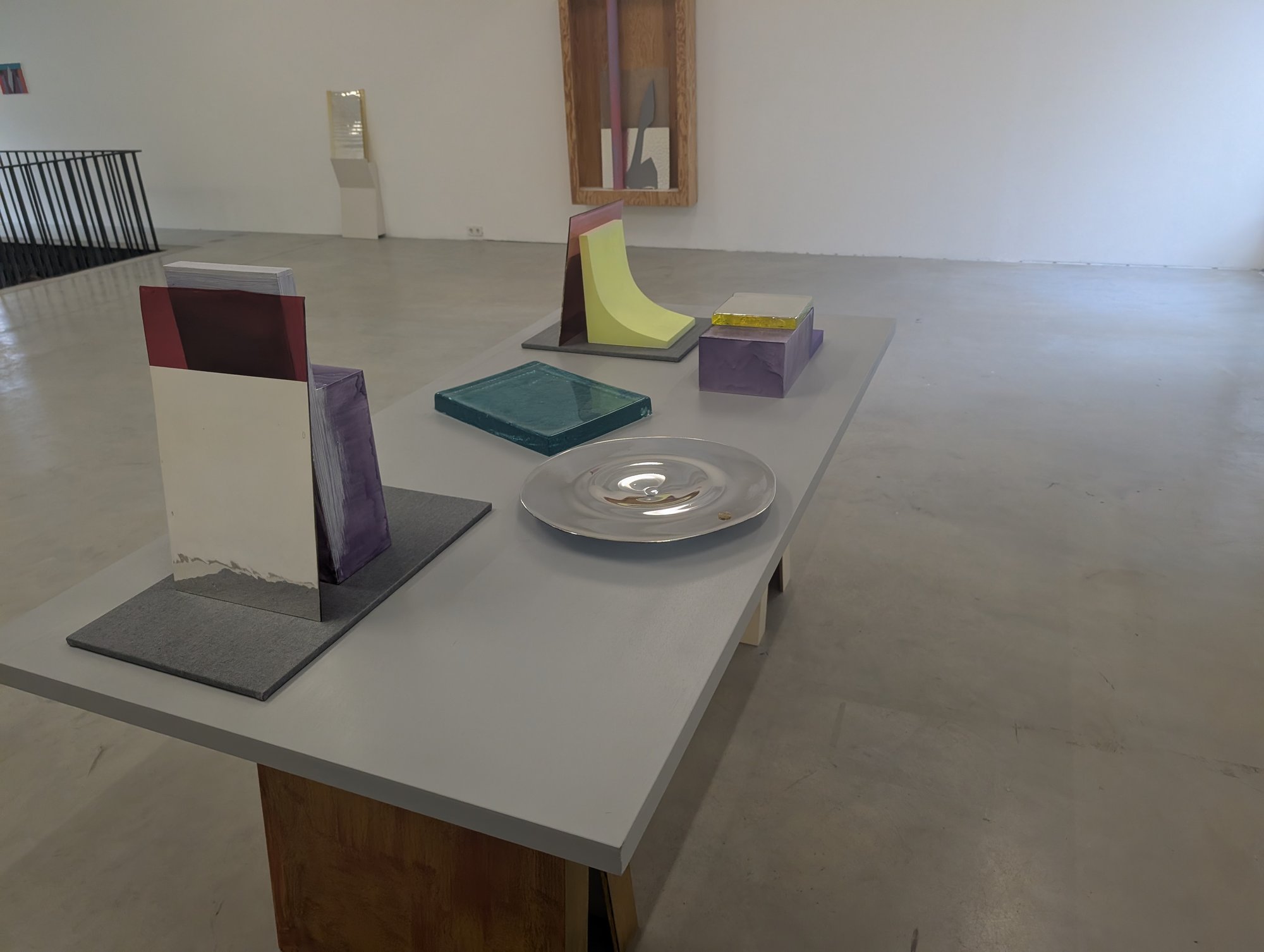
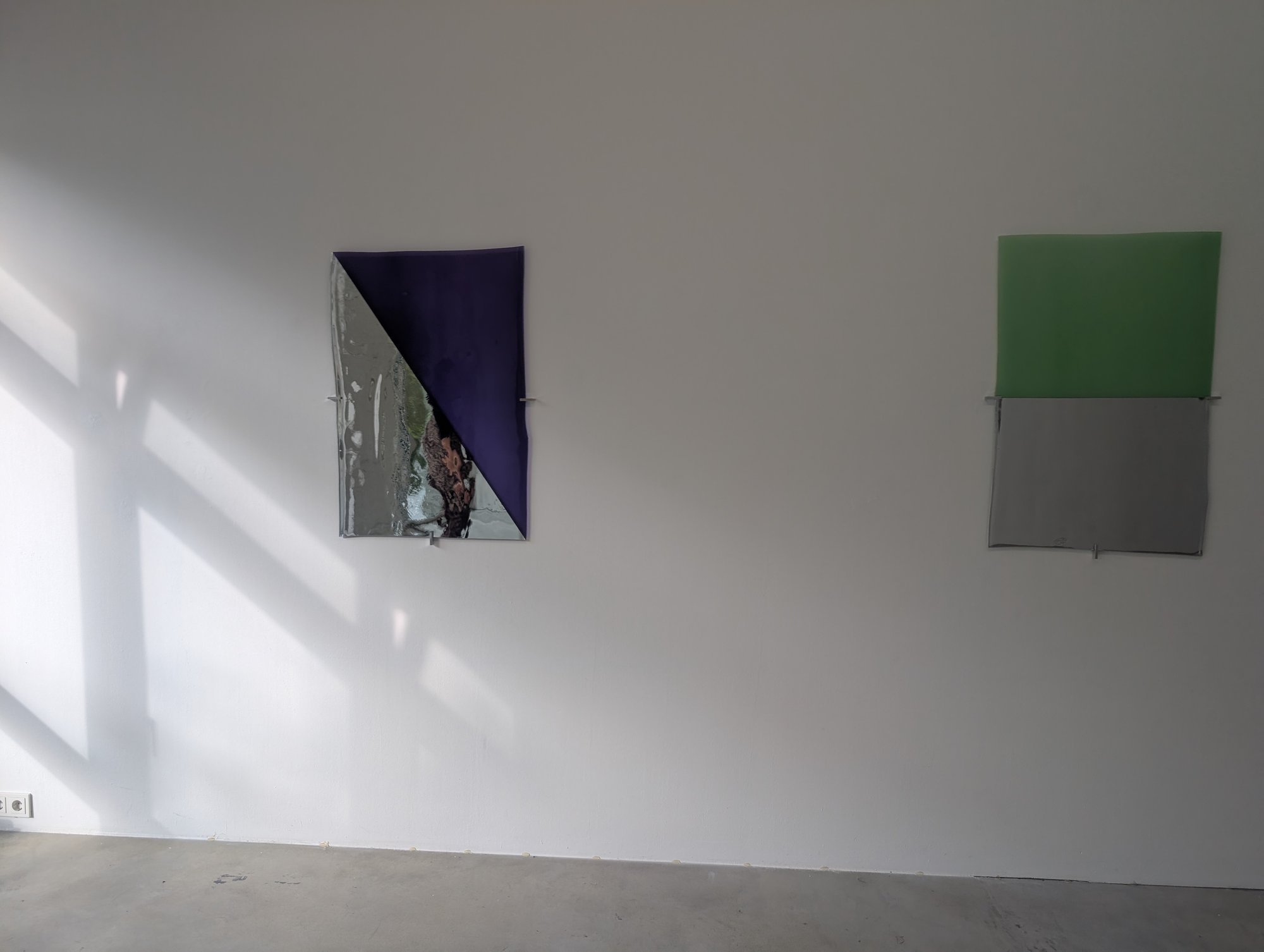
What is shown there is painting opening out towards the object. Undulating, curved plates are held off the wall on visible metal pins and cast shadows: one half opaque in sky blue or dark violet, the other mirrored with landscape-like streaks. A large hard-edge painting behind glass arranges orange-red, turquoise, yellow-green and two black bars into something that looks like a painted floor plan. On a trestle table small objects lie laid out on grey felt pads like samples: cast glass blocks in turquoise and violet, a flat glass dish with a swirling relief, yellow arc forms in front of pink glass. A box frame of knotty construction timber holds a red-brown column form. And on one long white wall the strongest exhibit is not a work at all but the diagonal shadow of a window cross.
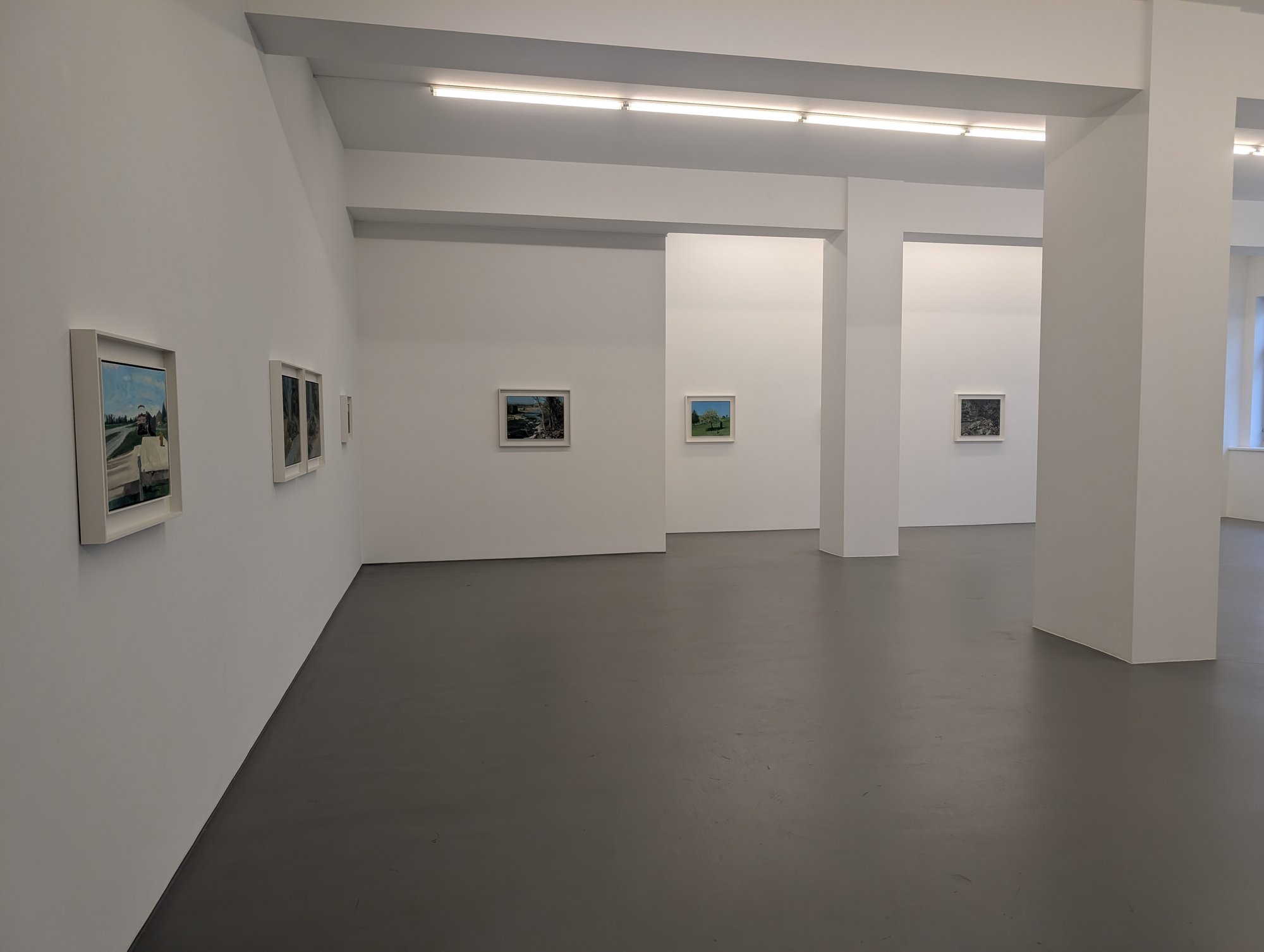
The second station is the opposite: a large white hall with downstand beams, two columns and wide openings, a dark grey glossy poured floor, a long fluorescent strip along the ceiling edge. In it hang, widely spaced and all at the same height, six or seven small-format pictures in deep white box frames: a tree in blossom on a green meadow, a farmstead on a road under clouds, a coastline with branches, a dark horizontal format with rubble, twigs with seed heads against strong blue, an interior with a figure silhouetted against the window. Muted colours, calm hanging, a great deal of wall.
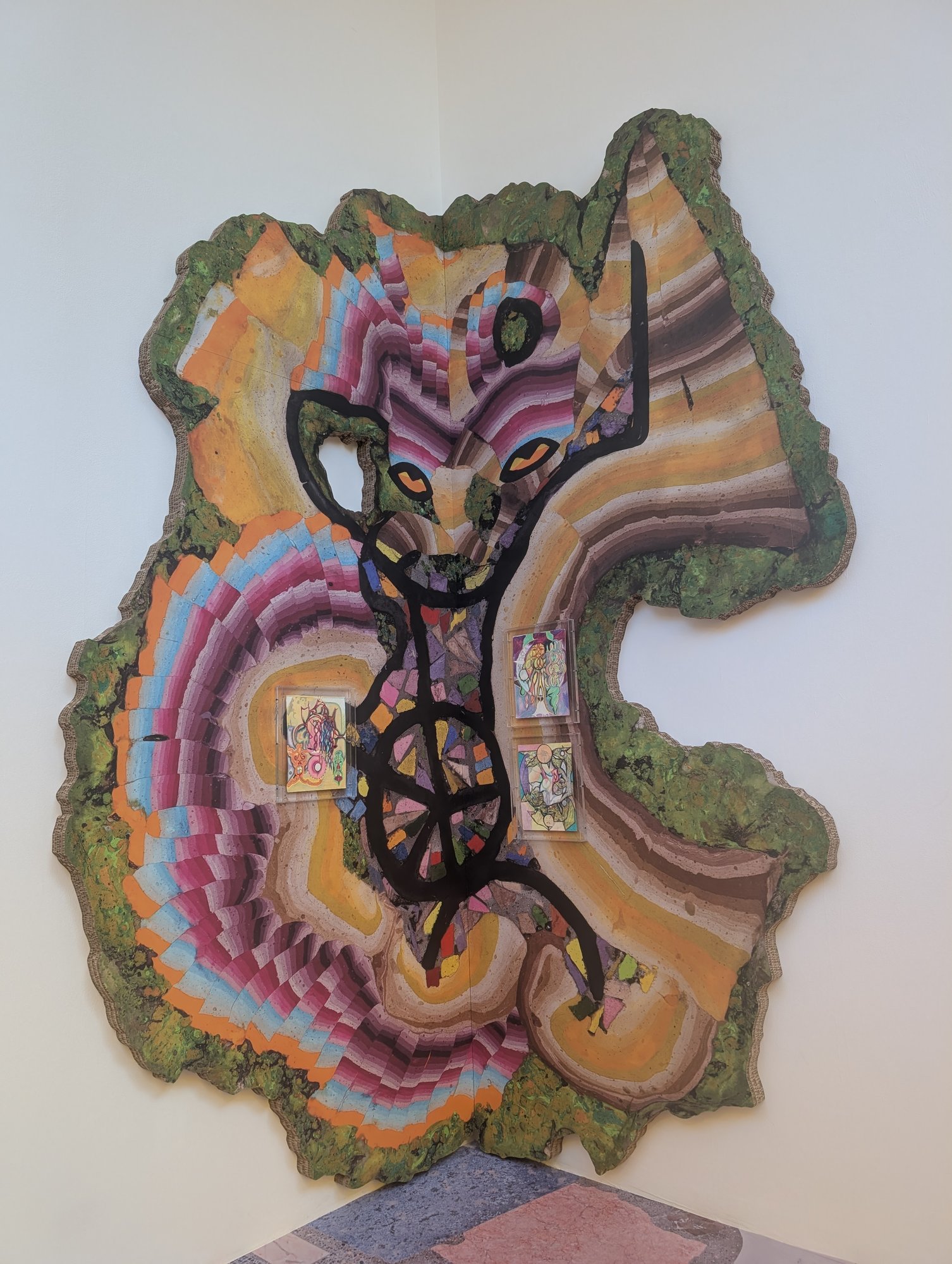
The third station works with colour right down into the floor. Large, freely contoured wall objects hang there, over two and a half metres tall, their surfaces built up like a cut agate: concentric rings in magenta, pale blue, orange and ochre, the edge crusted and moss green. Across them runs a broadly painted black line that draws an animal-like form with eyes picked out in yellow. Small drawings in clear acrylic boxes are mounted onto the objects. The floor is covered entirely by a marbled work in red, blue and pink that continues the colour of the wall, and one of the objects is bent across a corner of the room.
Three rooms, three positions, not a single name. That galleries do without labels is a decision, and it has its appeal: you look first and do not read. For a review it is impractical. As soon as I have the names, they will be added here.
Photographs: Florian Jäger, 13 September 2026.
Impressions