Published on
Vladimir Sorokin. The Blizzard
by Florian Jäger
Vladimir Sorokin, „Der Schneesturm“, in der Taiga Gallery. Foto: Florian Jäger, 13. September 2026
Sunday 13 September 2026, Markgrafenstraße 68. At Taiga Gallery, Vladimir Sorokin's "Der Schneesturm" — "The Blizzard" — has been running since 9 September and continues until 9 November. The gallery sheets are laid out in three languages, German, English and Russian, and they expressly describe the series not as the illustration of a book but as a parallel development of text and image. The material was on stage at the same time: the Komische Oper programme lists "Der Schneesturm" from 10 to 13 September in the main hall of the Schillertheater, a guest performance in the Kirill & Friends festival, directed and designed by Kirill Serebrennikov, with music by Alexander Manotskov.
The room is high and white, the floor smoothed concrete, the light comes from spotlights on black track rails. A free-standing partition creates a second line of sight. In the middle of the exhibition space stands a rolling piece of furniture with a wooden top on a black frame that serves as information desk and bar at once; beside it hangs a handwritten drinks list, three to six euros.
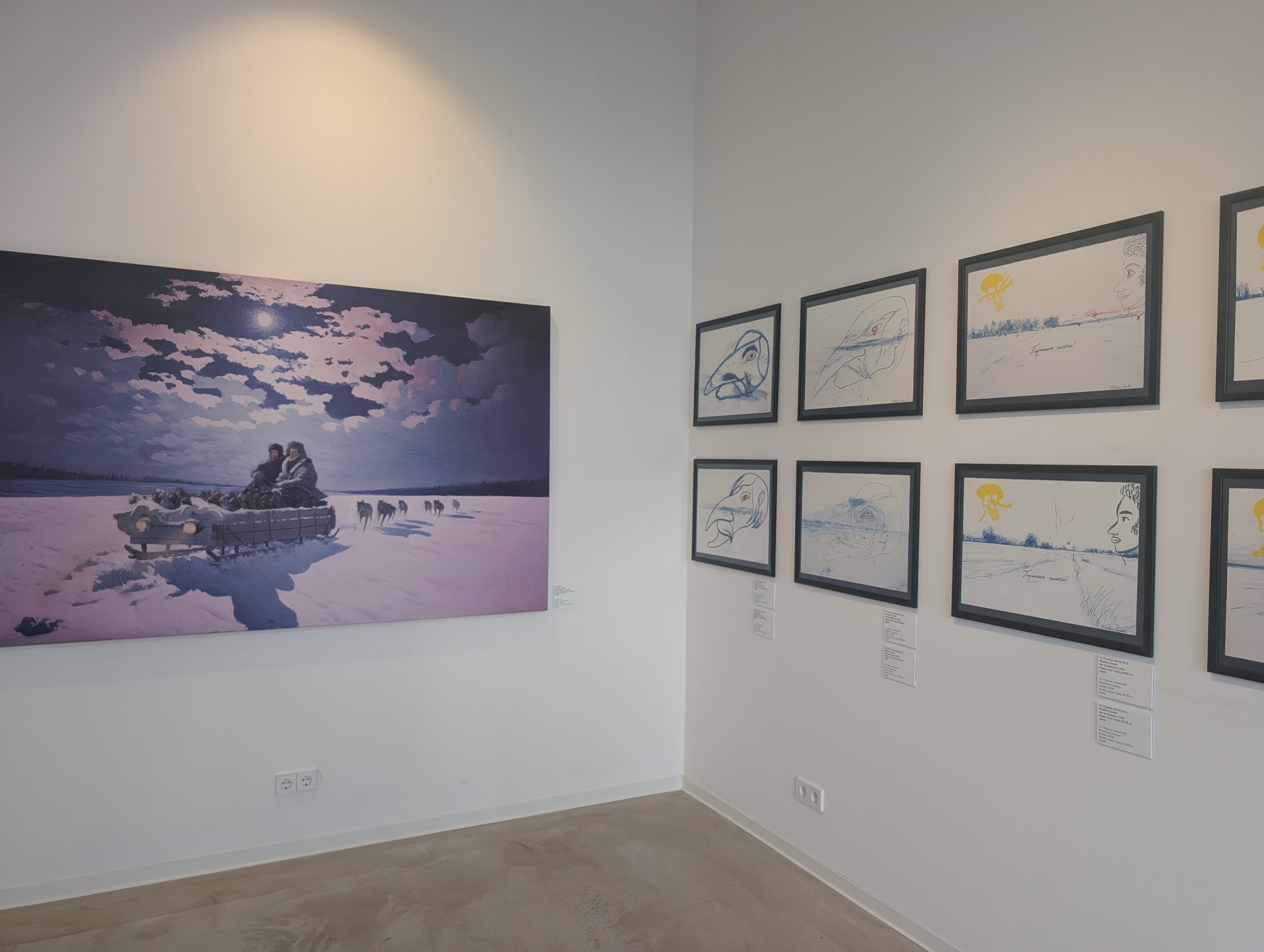
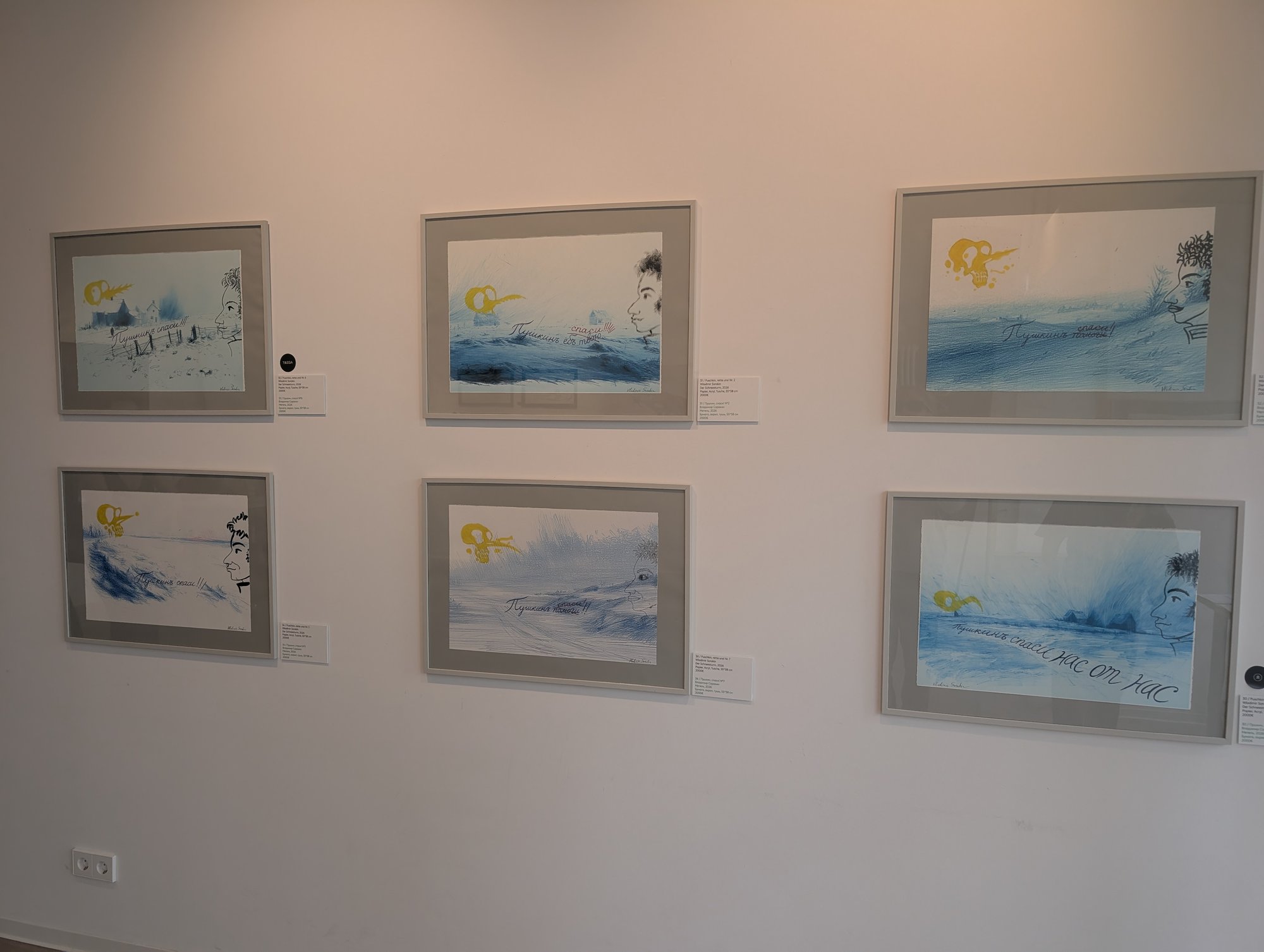
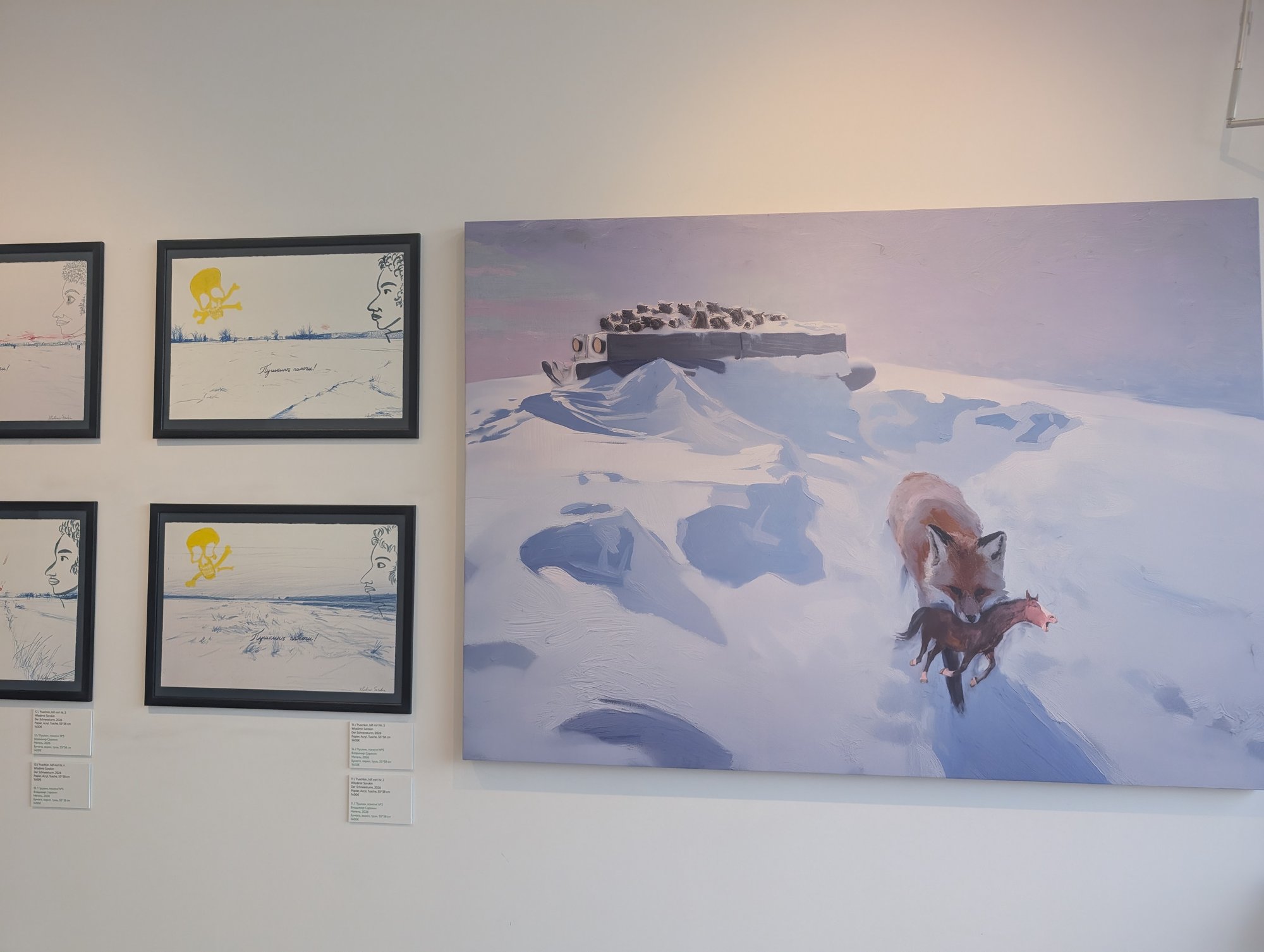
The hanging follows a single principle, carried through consistently: large unframed canvases hung singly against strictly gridded groups of small framed works on paper, two by two, two by three, two by four, with the labels below in double columns.
The narrative plays out on the canvases. A snow slope in blue-grey under a pink sky, with a stranded vehicle in it and a red fox carrying a small horse in its mouth — the same work is reproduced on the gallery sheet, "Morning After the Blizzard No. 2", 2026, print on canvas, 167 by 120 centimetres. On another wall a very wide night panorama: deep blue sky with pink-rimmed cloud and a full moon, below it a snowfield shimmering pink, a sledge with two figures sitting close together and a team of small horses moving in front of it. And a square interior, dark, with an icon and an animal skull on the wall, a woman smoking in bed in a white shirt and red boots.
The language plays out on the sheets of paper. All in the same format, 55 by 38 centimetres, paper, acrylic and ink, all from 2026: flat snow landscapes with huts, a fence and scrub, a yellow skull at the top left of each, a profile head in fine line at the right edge, unmistakably Pushkin with his curls. And written by hand across the landscape, always the same appeal. Once "Пушкинъ помоги!", Pushkin, help me. Once "Пушкинъ спаси!", Pushkin, save us. Once extended, in substance: save us from ourselves.
The labels turn this into two series, and here it gets interesting. Sheets from the "Pushkin, help me!" series cost 1,400 euros, those from "Pushkin, save us!" cost 2,000. Same format, same technique, same year; on the labels the two series differ only in the wording of the plea. That is either an oversight by the market or a very dry joke.
Photographs: Florian Jäger, 13 September 2026.
Impressions